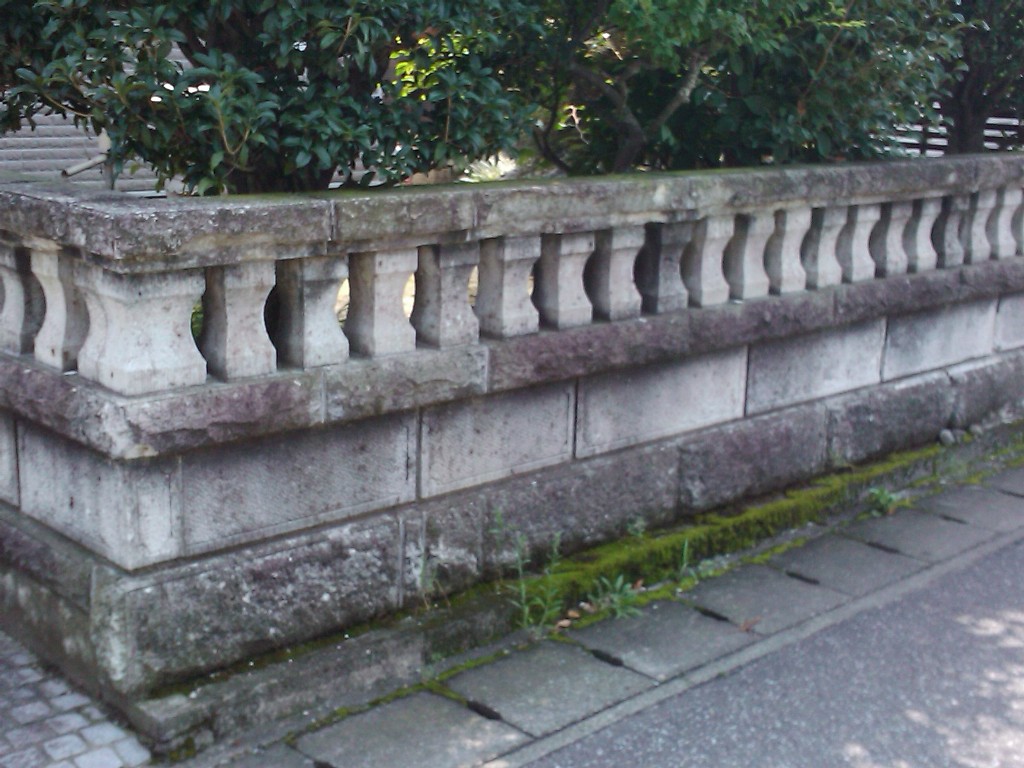
Very nice stonework on this warehouse in Otawara, Tochigi-ken, Japan.
My name is Jon and I live in Los Angeles. I've visited Japan a lot so that's what this blog is about...visiting Japan, Japanese history and samurai movies.
Daibutsu, Kamakura
Daibutsu in Kamakura, June 2010. There were thousands of school kids visiting that day. It was still great fun.
Showing posts with label Buildings. Show all posts
Thursday, June 14, 2012
Tuesday, May 08, 2012
Friday, April 27, 2012
Small Japanese Door
I posted this maybe last year but here it is again in black and white. I like this little door, maybe on 4 feet or 120 cm tall. This is from Otawara, Tochigi-ken.
Friday, March 09, 2012
Japan U.S. Mail Box
I found this house during a walk around Otawara, Tochigi-ken. I liked all the green vegetation around the entrance but what really caught my eye was the mail box. Sorry you can't make it out in the photograph but the mail box says U.S. Mail. The front door and little parking spot are a mere few feet from the road. I like how homes in Japan are closer to the roads, especially the quieter, narrower roads. It gives it a more intimate feeling for me.
Thursday, February 16, 2012
Nice Japanese Gate
Another gate I found in Otawara, Tochigi-ken. I really like this one because of the natural cut wood on the front of the gate. The gate enters into a very small entry way garden which I also like.
Friday, February 10, 2012
Another Old Japanese House
Here is another old Japanese house I found while walking around Otawara, Tochigi-ken. This appears to have doubled as a work house or farm house due to the size and shape. But there is no farm land in the immediate area anymore. Of course there used to be a lot of farm land around here 40 or 50 years ago.
Saturday, February 04, 2012
Old Japanese House
This is an old Japanese house in Otawara. I like the weathered look of the wood siding and the tile roof.
Wednesday, December 14, 2011
Meat Shop
Two meat shops in Otawara Tochigi-ken. These are both in the pub district neighborhood. But I don't think either of them sell meat. Someone lives above Meat Shop Torikin and when I walked by he was just opening the metal doors but I did not see any meat. The other meat shop appeared to be an abandoned haikyo building.
| Meat Shop Torikin that doesn't sell meat. |
| Meat Shop Haikyo |
Wednesday, November 16, 2011
Club Palette, Mickey, Amigo and Dead Space
- I found a club and bar district in the small Tochigi city of Otawara. The neighborhood is called Chuo. There were dozens and dozens of bars and pubs within a small neighborhood. I will post photos of some of them. Here is Club Palette, Club Mickey, Club Amigo (I think) and Club Dead Space.
Wednesday, October 05, 2011
How Japan's Oldest Wooden Building Survives Giant Earthquakes
Below is an interesting article on how Japan's ancient pagoda's survive earthquakes and weather.
How Japan's Oldest Wooden Building Survives Giant Earthquakes
BY ANDREW TARANTOLA OCT 5, 2011 11:30 AM
How Japan’s Oldest Wooden Building Survives Giant Earthquakes
Japan has been struck by magnitude 7.0 or greater earthquakes a staggering 46 times since the pagoda at the Horyu-Ji Temple was built in 607AD. So, how did the 122 foot tall structure stay upright through all that shaking?
Multi-story pagoda technology arrived in Japan during the sixth century alongside Buddhism from China. On the mainland, pagodas were traditionally built of stone. However given Japan's seismic instability and higher annual rainfall, that design was simply untenable. But, after much experimentation, Japanese builders figured out how to adapt them to the shaky conditions through three design changes: the use of wide and heavy eaves, disconnected floors, and a shock-absorbing shinbashira.
Japan is a wet country with roughly double China's annual precipitation. So, to keep rainwater from running off building and onto the soil surrounding the foundation, potentially causing the pagoda to sink, builders extended the eaves far away from the walls—constituting up to 50 percent or more of the building's total width. Builders employed a series of cantilevered beams to prop up the massive overhangs. Then, to combat the buildings' severe flammability, the eaves were then laden with heavy earthenware to prevent tinders from igniting the wooden structure underneath.
Side note: Boy are pagodas flammable. The Toji pagoda, Japan's tallest wooden structure, has burned to the ground after being struck by lightning three times since its first building in 824. Fire-by-lightning-strike is actually the primary way that pagodas are destroyed, hence the inclusion of the large metal spire on the roof that acts as a lightning rod. In fact, only two Japanese pagodas in the last 1400 years, the pair at Todai-ji temple, are known to have actually collapsed from shaking alone.
The wide and heavy eaves aren't only good for fire protection, they also act as enormous stabilizers with a huge amount of inertia that must be overcome for the building to begin swaying. And even with the strongest of jolts, the eaves will cause the building to gently sway rather than shake.
The Horyu-ji pagoda doesn't have any central load-bearing beams like you'd see in modern construction. Since the building tapers as it rises, no single load-bearing vertical beam connects to the one below it. The individual floors themselves aren't solidly connected to their neighbors either, just piled atop one another with loose-fitting brackets. This is actually a big advantage in earthquake country. During a shake, the floors will sway in a slithering fashion, with each floor moving in the opposite direction of the ones immediately above and below. This allows the building to more fluidly ride the seismic wave than a more solid building would.
To keep the floors from flexing too far, builders came up with an ingenious solution—the shinbashira. It looks like a large load-bearing column, but it doesn't actually support any of the building's weight (that weight is supported by a network of 12 outer and four inner columns). Built from a large pine trunk, the shinbashira is strung from the underside of the roof and hangs down a shaft in the center of the structure. Sometimes it's buried into the earth, sometimes it rests lightly atop the ground, and occasionally it doesn't even touch the ground—it just freely hangs. The shinbashira acts as a massive tuned mass damper, helping to mitigate the earthquake's vibrations. It also prevents the floors from swaying to the point of collapse and absorbs some of the momentum of the floors as they strike against it. Basically, it's a giant stationary pendulum with enough mass to prevent the lighter floors from freely swinging around.
This same damping technology is still in use today. The The Taipei 101 employs a massive 4-story, 730-ton steel pendulum hung from the 92nd floor to prevent the building from swaying in high winds. The Citicorp Center in New York, uses a 400 ton concrete block to prevent movement during hurricanes.
[Wikipedia 1, 2, 3 - Economist - Asia Times - National Information Service for Earthquake Engineering- Top image courtesy of (c)Tomo.Yun (www.yunphoto.net/en/) ]
Monster Machines is all about the most exceptional machines in the world, from massive gadgets of destruction to tiny machines of precision, and everything in between.
How Japan's Oldest Wooden Building Survives Giant Earthquakes
BY ANDREW TARANTOLA OCT 5, 2011 11:30 AM
How Japan’s Oldest Wooden Building Survives Giant Earthquakes
Japan has been struck by magnitude 7.0 or greater earthquakes a staggering 46 times since the pagoda at the Horyu-Ji Temple was built in 607AD. So, how did the 122 foot tall structure stay upright through all that shaking?
Multi-story pagoda technology arrived in Japan during the sixth century alongside Buddhism from China. On the mainland, pagodas were traditionally built of stone. However given Japan's seismic instability and higher annual rainfall, that design was simply untenable. But, after much experimentation, Japanese builders figured out how to adapt them to the shaky conditions through three design changes: the use of wide and heavy eaves, disconnected floors, and a shock-absorbing shinbashira.
Japan is a wet country with roughly double China's annual precipitation. So, to keep rainwater from running off building and onto the soil surrounding the foundation, potentially causing the pagoda to sink, builders extended the eaves far away from the walls—constituting up to 50 percent or more of the building's total width. Builders employed a series of cantilevered beams to prop up the massive overhangs. Then, to combat the buildings' severe flammability, the eaves were then laden with heavy earthenware to prevent tinders from igniting the wooden structure underneath.
Side note: Boy are pagodas flammable. The Toji pagoda, Japan's tallest wooden structure, has burned to the ground after being struck by lightning three times since its first building in 824. Fire-by-lightning-strike is actually the primary way that pagodas are destroyed, hence the inclusion of the large metal spire on the roof that acts as a lightning rod. In fact, only two Japanese pagodas in the last 1400 years, the pair at Todai-ji temple, are known to have actually collapsed from shaking alone.
The wide and heavy eaves aren't only good for fire protection, they also act as enormous stabilizers with a huge amount of inertia that must be overcome for the building to begin swaying. And even with the strongest of jolts, the eaves will cause the building to gently sway rather than shake.
The Horyu-ji pagoda doesn't have any central load-bearing beams like you'd see in modern construction. Since the building tapers as it rises, no single load-bearing vertical beam connects to the one below it. The individual floors themselves aren't solidly connected to their neighbors either, just piled atop one another with loose-fitting brackets. This is actually a big advantage in earthquake country. During a shake, the floors will sway in a slithering fashion, with each floor moving in the opposite direction of the ones immediately above and below. This allows the building to more fluidly ride the seismic wave than a more solid building would.
To keep the floors from flexing too far, builders came up with an ingenious solution—the shinbashira. It looks like a large load-bearing column, but it doesn't actually support any of the building's weight (that weight is supported by a network of 12 outer and four inner columns). Built from a large pine trunk, the shinbashira is strung from the underside of the roof and hangs down a shaft in the center of the structure. Sometimes it's buried into the earth, sometimes it rests lightly atop the ground, and occasionally it doesn't even touch the ground—it just freely hangs. The shinbashira acts as a massive tuned mass damper, helping to mitigate the earthquake's vibrations. It also prevents the floors from swaying to the point of collapse and absorbs some of the momentum of the floors as they strike against it. Basically, it's a giant stationary pendulum with enough mass to prevent the lighter floors from freely swinging around.
This same damping technology is still in use today. The The Taipei 101 employs a massive 4-story, 730-ton steel pendulum hung from the 92nd floor to prevent the building from swaying in high winds. The Citicorp Center in New York, uses a 400 ton concrete block to prevent movement during hurricanes.
[Wikipedia 1, 2, 3 - Economist - Asia Times - National Information Service for Earthquake Engineering- Top image courtesy of (c)Tomo.Yun (www.yunphoto.net/en/) ]
Monster Machines is all about the most exceptional machines in the world, from massive gadgets of destruction to tiny machines of precision, and everything in between.
Tuesday, April 12, 2011
Small Door
I love Japanese walls for some reason. The texture of the various types of stone, the colors, the different styles with the top caps, etc. The wall below was interesting because of the door. The door is about 3 to 4 feet tall (0.9 to 1.2 meters). I really like the arched stone above this small door and the rough stone looks very nice. The stone lip about a foot from the ground also really makes this wall look nice in my opinion. This photo is one I took from Otawara in Tochigi prefecture in August 2010.

See more great Show Me Japan photos currently being hosted by ichigoichielove.
Thursday, September 23, 2010
Japan Photos - Something is Missing
While walking around my local Otawara Tochigi-ken neighborhood I came across these two garage/storage buildings. Both of these buildings are about 5 minute walk from each other. Do you notice something missing in each photo?


Yes, both garage/storage buildings are missing the number four. The reason is the number four in Japan is an unlucky number. The number four is considered inauspicious because it is pronounced the same as the word for death (shi). Therefore, one should not make presents that consist of four pieces, etc. In some hotels and hospitals the room number four is skipped. It seems the owners of these garage/storage buildings did not want to bring bad luck on their cars or tools.
Wednesday, September 15, 2010
Pasadena teahouse sent to Japan for restoration, then returned to America
I like to periodically post Japan related articles that I find especially interesting and this is one from the Los Angeles Times.
The Japanese tea ceremony has a long history and was also popular among some of Japan's greatest samurai warlords such as the powerful Oda Nobunaga and the great unifier Toyotomi Hideyoshi of the late 16th century. The great tea practitioner from the late 16th century, Sen no Rikyu, was also an influential political confidant of Hideyoshi. But Rikyu somehow angered the great warlord, most likely some sort of political intrigue, and Hideyoshi ordered Rikyu to commit seppuku, ritual suicide. This is interesting because seppuku was generally performed only by a samurai, which Rikyu was not. This shows the important place in society that Rikyu held.
A Pasadena teahouse, falling on hard times, will be sent to Japan for restoration, then return to grace a new garden at the Huntington Library.
By Teresa Watanabe, Los Angeles Times
September 12, 2010
Japan's Grand Master of the Phoenix Cloud visited Los Angeles four decades ago and dedicated an exquisite teahouse to the public in the hopes of popularizing the sublime art of tea ceremony in the West.
Trained as a kamikaze pilot during World War II, the grand master saw tea as a way to promote peace, share Japan's cultural treasures and repair a national image battered by wartime militarism. The 400-year-old art expresses the values of harmony, respect, purity and tranquillity through the highly refined and ritualized making and serving of tea.
But the ceremony failed to catch on much beyond a small circle of Japanese Americans. The teahouse, given to the Pasadena Buddhist Church, declined in use. Termites began attacking the wood and paper structure, and the elderly couple who cared for the teahouse for decades no longer could do so.
The Huntington Library, Art Collections and Botanical Gardens in San Marino has stepped in to rescue the teahouse as part of an ambitious $6.7-million project to restore its Japanese garden and develop an authentic tea garden. In collaboration with the grand master's Urasenke School and the Buddhist church, the Huntington hopes to use the teahouse to expose the art to a broader swath of society and develop a premier program for Asian garden arts, including the tea ceremony, flower arranging, bonsai and stone viewing.
James Folsom, the Huntington's botanical gardens director, said the ancient Japanese art is as relevant to Americans today as it was to the Zen monks and warring samurai who practiced it four centuries ago.
"When life is so hectic, when you're rushing around looking at e-mails, how do you remind yourself to stop and be human again?" Folsom said. "The tea ceremony reminds us to step out of that, to appreciate silence and tranquillity in the presence of others and to enjoy the beauty of the moment. We would hope that tea helps lead people to a change in their own lives."
The Urasenke Tankokai Los Angeles Assn. offered a farewell bowl of tea to several guests in the Pasadena teahouse. The house, designed by the grand master's brother, Sen Mitsuhiko, is a light and airy structure featuring woven bamboo ceilings, white papered shoji screens, bamboo tatami mats and the all-important alcove displaying the day's carefully selected Japanese scroll, vase and flower arrangement.
The gathering's hostess, Soen Clarkson, performed the tea ceremony's ritualized acts: First, fold a silk cloth to wipe the tea caddy and tea scoop. Place the powdered green tea in a specially selected bowl. Pour in water heated over a charcoal brazier. Whip the mixture into a froth with a bamboo whisk. Then, offer it to the guests along with Japanese sweets.
As the guests sipped tea, Robert Hori, vice president of Urasenke's Los Angeles chapter and director of advancement at the Japanese American Cultural & Community Center, explained his choices in selecting the various accoutrements for the occasion. The careful consideration of such items is part of the tea ceremony's spirit of hospitality as the host aims to capture the gathering's treasured and irreplaceable moment.
The boat-shaped vase pointing outward symbolized the teahouse's departure from the Pasadena church, he said. A Rose of Sharon and bush clover, both short-lived blooms, reflect the transiency of life. The scroll of Japanese calligraphy was used when the grand master dedicated the teahouse, named the Arbor of the Pure Breeze, in Pasadena in 1965.
And for the day's tea scoop, Hori selected a utensil named "gratitude."
"We're really grateful for the opportunity to give the teahouse a new life," he said. "It's the end and it's the beginning."
Tea was first taken to Japan from China by a Buddhist monk in the 9th century. But it was not until the 16th century that Sen Rikyu perfected the Way of Tea by incorporating into it Zen elements of simplicity and oneness with nature. By designing a teahouse with an entrance forcing guests to lower their heads and crawl through, the tea master also sought to eliminate social distinctions.
Fourteen generations later, Sen's direct descendent, Tantansai — the Grand Master of Purity and Serenity — served tea to American Occupation forces in Japan. That, in turn, inspired his son Hounsai to move beyond his military training and lingering disdain for Americans and dedicate his life to international harmony through tea. In 1965, he visited the United States to officially dedicate the teahouse his father had bequeathed to the church.
Sosei Matsumoto, a 90-year-old tea master lauded for her accomplishments by President Clinton and the emperor of Japan alike, was the first to teach tea ceremony in the new Pasadena teahouse. The structure, she recalled Sunday, was used for classes every week, with special tea ceremonies for New Year's and the summer Obon festival honoring ancestors.
But the Pasadena tea group failed to expand and dwindled to about seven students, said Yaeko Sakahara, also 90, who took over the classes from Matsumoto more than three decades ago. One of the major obstacles, she and others said, is the traditional requirement to sit on bamboo mats with legs folded under, a position that can turn legs numb after a few minutes. Tea ceremonies can last from 20 minutes to four hours.
Another obstacle to sustaining interest in tea is growing acculturation among younger generations of Japanese Americans, said Irene Takemori, Pasadena temple president.
"The younger generation is more interested in sports and don't have a lot of time for this cultural stuff," Takemori said. "It's really a shame, because it's such a beautiful experience to drink tea and find peace of mind."
When health issues began to preoccupy Sakahara, the teahouse's future hung in the balance.
Enter the Huntington. The renowned cultural institute had been looking for a Japanese teahouse after one of its donors, Mary B. Taylor Hunt, bequeathed a $2.6-million endowment for an authentic Japanese tea garden and related cultural programs. The Huntington's nine-acre Japanese garden, designed by founder Henry Huntington and William Hertrich, reflects a Western interpretation of Japanese aethestics but is not considered authentic, Folsom said.
After months of consideration, the Pasadena Buddhist Church decided earlier this year to donate the teahouse, clearing the way for the transfer.
The Huntington plans to close the current Japanese garden next year for several months of renovation, including restoration of its ponds and a traditional Japanese house. The new two-acre garden will be installed behind the house, along with the Pasadena teahouse. The grand reopening is expected to occur in 2012, in time for the garden's centennial anniversary, Folsom said.
This week, carpenters from Japan are scheduled to fly to Los Angeles and begin dismantling the teahouse. The pieces will be shipped to Kyoto, restored, then sent back to the Huntington.
Folsom said the Huntington, working with the region's tea schools and the Buddhist church, will seek to popularize the Japanese art, possibly using more ceremonial forms that allow practitioners to sit in chairs rather than on folded legs, among other ideas.
For the longtime guardians of the teahouse, Sunday's farewell was bittersweet.
"The teahouse has been an integral part of the temple, so it's a little sad to have it depart," Takemori said. "But it's in the best public interest and for the best use of the teahouse."
Monday, September 13, 2010
Japan Photos - A gate with no walls
Nice gate entrance to this home.

But I don't see it really providing much security.
I have seen these types of wall-less gates on other Japan blogs from around Japan. Curious as to the point of the gates with no walls. Are they unfinished projects? Did the homeowner run out of money? This particular gate is in Otawara in Tochigi and has been this way since my first visit in 2002.
I have seen these types of wall-less gates on other Japan blogs from around Japan. Curious as to the point of the gates with no walls. Are they unfinished projects? Did the homeowner run out of money? This particular gate is in Otawara in Tochigi and has been this way since my first visit in 2002.Friday, September 03, 2010
Japan Photos - Japanese Walls
I just returned from a one week trip to Japan. Since it was such a short trip I did not do any sightseeing to places such as Kamakura or Nikko. I enjoyed the trip nonetheless and took many walks around a small neighborhood in Otawara in Tochigi prefecture where I took a number of photos which I will post over the next few weeks. I apologize for the quality of some of the photos. I am very much a novice photographer and I took these with my Android phone.
One of the things I like about Japan are the walls that surround most Japanese homes. They come in many different styles and sizes and are made with interestingly textured stone or cinder block. Below are some photos I took of some walls in the Otawara neighborhood during the last week of August.
Below is a newer wall surrounding a relatively new house. I prefer the older heavier looking Japanese stone walls versus this more modern wall but it still looks nice and a lot better than most walls I see around Los Angeles.

Below is my favorite type of stone. I love the texture and naturalness of the stone used in this wall as well as the cap stones placed along the top.


Wednesday, February 17, 2010
The "Edo way" consumed less
Edo way consumed less: book | The Japan Times Online:
Here is an interesting article from the Japan Times. The article is about a book from author Azby Brown, a professor at Kanazawa Institute of Technology. The book describes how conservation techniques from the late Edo Period (1603-1868) can be emulated today.
"The lifestyle of people in Japan around 200 years ago, which was guided by the principle of consuming less, would help to create a sustainable society in the 21st century, an American expert on Japanese architecture said."
Brown states that people in the Edo Period overcame many of the same problems confronting present-day society — issues of energy, water, materials, food and population — in unique ways.
One of the points that Brown makes which I completely agree with is how in the United States, most Americans live in homes that are far larger then they actually need.
Here is an interesting article from the Japan Times. The article is about a book from author Azby Brown, a professor at Kanazawa Institute of Technology. The book describes how conservation techniques from the late Edo Period (1603-1868) can be emulated today.
"The lifestyle of people in Japan around 200 years ago, which was guided by the principle of consuming less, would help to create a sustainable society in the 21st century, an American expert on Japanese architecture said."
Brown states that people in the Edo Period overcame many of the same problems confronting present-day society — issues of energy, water, materials, food and population — in unique ways.
One of the points that Brown makes which I completely agree with is how in the United States, most Americans live in homes that are far larger then they actually need.
Thursday, January 14, 2010
NYC’s 'skinniest' house sells for $2.1 million - Real estate- msnbc.com
NYC’s 'skinniest' house sells for $2.1 million - Real estate- msnbc.com: "A town house dubbed New York City's skinniest house has sold for $2.1 million.
The red, 9 1/2 foot wide, 42 foot long brick building in Greenwich Village was built in 1873 on land used as an alley between homes. The town house was listed for sale last August at $2.7 million. The two bedroom, two bath home last sold in 2000 for $1.6 million."
This makes the national news on MSNBC but this is a pretty typical size building in Japan, especially Tokyo.
Tuesday, January 12, 2010
Narrow Buildings
Japan is famous for having extremely narrow highrise buildings, especially in Tokyo. I actually really like these interesting buildings. Maybe I would like them so much if I had to live in one. However, this four-story building below with the large windows facing the river looks really cool. This photo is from the really interesting blog from Muza-chan. Muza-chan often posts about the narrow buildings of Japan and this building from her recent post really caught my eye due to the large windows and the great location fronting the river.

It looks like someone is looking out the window from the small building next door. Probabaly enjoying the sites of the river.
Sunday, January 03, 2010
Swaying Teahouse in Japan
Check out this teahouse that is built atop two chestnut trees. It is located in Nagano Prefecture and is called the takasugi-an teahouse which I believe means a teahouse too-high. The teahouse sways gently when there is a breeze. I don't see how it could stand up to anything more than a breeze though.


Monday, September 28, 2009
Gojunoto - The five story Nikko pagoda
The Gojunoto is an 1818 reconstruction of the original five-storied pagoda, which was erected in 1650, but which was lost in a fire in 1815. In order to make the tower stable enough to resist wind and earthquake forces, the center pillar is suspended on the fourth story and held 10 cm above the ground -- not resting on a foundation stone -- thereby functioning as a dynamic counterweight which maintains the center of gravity.
Subscribe to:
Comments (Atom)