Takashi Miike has remade one of the greatest samurai films of them all, Hara Kiri. The original is my favorite samurai film of the over 100 I've seen which include Seven Samurai, Ran and others. The brilliant Tatsuya Nakadai stars in the original so I am very curious how well Miike did in remaking this masterpiece, especially since he has chosen to make this film in 3D.
Daibutsu, Kamakura

Daibutsu in Kamakura, June 2010. There were thousands of school kids visiting that day. It was still great fun.
Showing posts with label Samurai Flicks. Show all posts
Showing posts with label Samurai Flicks. Show all posts
Monday, October 24, 2011


Friday, May 06, 2011
Takashi Miike: Why I am bringing Japanese classics back to life
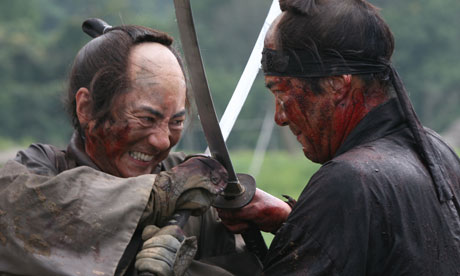
From the Guardian UK, the Japanese director explains why he has returned to the chanbara samurai films of his youth for his new film 13 Assassins and the up coming remake of the incredible film, Hara Kiri.

It was two years ago, when I was watching the classic 1963 samurai film 13 Assassins, that I was struck by the sheer power and energy the Japanese film industry possessed in its heyday. But I also immediately felt sad, because we have lost the ability to make films like that. I wanted to resurrect this creative spirit. That's why I decided to do a remake.
I was only three years old when the original came out. It's popular among samurai movie fans – a legendary film for my father's generation, among the many fine chanbara (samurai films) made at the time. Most of all, I love the Zatoichi series about the blind swordsman, especially the first one, from 1962. It's a masterpiece. Then there are the films of Hideo Gosha: Kumokiri Nizaemon (Bandits vs Samurai Squad, 1978) and Yami no Karyudo (Hunter in the Dark, 1979). They are a bit on the B-movie side, but they are interesting, cool and very stylish. And of course Akira Kurosawa's Seven Samurai has to make the list; I don't think any Japanese film-maker can escape the influence of Kurosawa.
I felt that all of us working on our remake of 13 Assassins had to honour the original director, Eiichi Kudo, and everyone else who created the original. It was important to avoid doing what most modern-day chanbara do, which is to insert a love story, or interpose modern-day mindsets. Over the years, people have remade Kurosawa movies, but failed every time because they have not been able to adapt the story into something young audiences can understand.
The story takes place in the 1840s, near the end of the Edo period. But some things never change: mankind is always in pain, no matter what the age, place or political system. I don't need to insert "contemporary themes" into the film – these samurai speak to us even though we are not samurai. That, for me, is the beauty of these period films. Perhaps the samurai genre is unique, even though we Japanese live in an international world where we share the same information and use the same products. But then again, you could compare samurai movies to westerns, in that they're both long-lasting genres in which the characters and the audiences are mainly men. As men, we want to see some kind of ideal of masculinity, even though modern society might restrict us in our own lives.
I wanted to make 13 Assassins in the old manner, to use old techniques and not to rely on modern-day ones such as CGI, or editing that changes the speed. We only had two weeks to film, and the weather up in Yamagata prefecture in the north, where we built the set for the village where the climactic battle takes place, was pretty bad. The actors did surprisingly well, considering that more than half of the main 13 had never held a sword or ridden a horse. They were fighting for their lives as actors.
Have I managed to resurrect the genre? Maybe 13 Assassins is the mortal agony and death rattle of a Japanese film industry that has abandoned its creative talent. But I've got another chanbara on the way, which I'm editing for Cannes right now. It's called Hara-Kiri: Death of a Samurai, and is based on the 1962 film by the famous director Masaki Kobayashi. And it's going to be in 3D. As a film-maker, it's only natural to feel happy about new possibilities opening up. I picture myself 20 years from now, when 3D is the norm, telling my grandkids: "In the old days, we actually argued about whether 2D was better."
Takashi Miike was talking to Phil Hoad.
It was two years ago, when I was watching the classic 1963 samurai film 13 Assassins, that I was struck by the sheer power and energy the Japanese film industry possessed in its heyday. But I also immediately felt sad, because we have lost the ability to make films like that. I wanted to resurrect this creative spirit. That's why I decided to do a remake.
I was only three years old when the original came out. It's popular among samurai movie fans – a legendary film for my father's generation, among the many fine chanbara (samurai films) made at the time. Most of all, I love the Zatoichi series about the blind swordsman, especially the first one, from 1962. It's a masterpiece. Then there are the films of Hideo Gosha: Kumokiri Nizaemon (Bandits vs Samurai Squad, 1978) and Yami no Karyudo (Hunter in the Dark, 1979). They are a bit on the B-movie side, but they are interesting, cool and very stylish. And of course Akira Kurosawa's Seven Samurai has to make the list; I don't think any Japanese film-maker can escape the influence of Kurosawa.
I felt that all of us working on our remake of 13 Assassins had to honour the original director, Eiichi Kudo, and everyone else who created the original. It was important to avoid doing what most modern-day chanbara do, which is to insert a love story, or interpose modern-day mindsets. Over the years, people have remade Kurosawa movies, but failed every time because they have not been able to adapt the story into something young audiences can understand.
The story takes place in the 1840s, near the end of the Edo period. But some things never change: mankind is always in pain, no matter what the age, place or political system. I don't need to insert "contemporary themes" into the film – these samurai speak to us even though we are not samurai. That, for me, is the beauty of these period films. Perhaps the samurai genre is unique, even though we Japanese live in an international world where we share the same information and use the same products. But then again, you could compare samurai movies to westerns, in that they're both long-lasting genres in which the characters and the audiences are mainly men. As men, we want to see some kind of ideal of masculinity, even though modern society might restrict us in our own lives.
I wanted to make 13 Assassins in the old manner, to use old techniques and not to rely on modern-day ones such as CGI, or editing that changes the speed. We only had two weeks to film, and the weather up in Yamagata prefecture in the north, where we built the set for the village where the climactic battle takes place, was pretty bad. The actors did surprisingly well, considering that more than half of the main 13 had never held a sword or ridden a horse. They were fighting for their lives as actors.
Have I managed to resurrect the genre? Maybe 13 Assassins is the mortal agony and death rattle of a Japanese film industry that has abandoned its creative talent. But I've got another chanbara on the way, which I'm editing for Cannes right now. It's called Hara-Kiri: Death of a Samurai, and is based on the 1962 film by the famous director Masaki Kobayashi. And it's going to be in 3D. As a film-maker, it's only natural to feel happy about new possibilities opening up. I picture myself 20 years from now, when 3D is the norm, telling my grandkids: "In the old days, we actually argued about whether 2D was better."
Takashi Miike was talking to Phil Hoad.
Tuesday, May 03, 2011
13 Assassins
Here is the trailer for the AWESOME looking 13 Assassins that is now playing in the United States. Here is a listing of where it is showing. 13 Assassins is a remake of the original 1963 film and is directed by Takashi Miike. Miike also directed such famous films as Sukiyaki Western: Django, Ichi The Killer, and Yakuza Demon. Although a remake, this film has been getting some very good reviews, apparently the sword fighting and battle scenes are very impressive and violent. The director clearly wanted to give the feeling of the reality and horror of the actual combat, just like was done in the movie Saving Private Ryan. This is showing in Los Angeles so I will make every attempt I can to see this incredible looking samurai film.
Monday, September 27, 2010
Trailer - The Last Chushingura
From Nippon Cinema:
A 2-minute trailer was released for Shigemichi Sugita‘s The Last Chushingura, a new film adaptation of Shoichiro Ikemiya’s 1994 novel which was previously made into a 2004 NHK TV drama.
The film stars Koji Yakusho and Koicho Sato as the only two survivors of the legendary raid in which 47 ronin killed a corrupt court official named Kira Yoshinaka for the honor of their executed master knowing full well they’d be forced to commit seppuku afterward. Sato’s character, Terasaka Kichiemon, is a loyal retainer who’s secretly ordered to escape the raid by his leader, Oishi Kuranosuke, in order to relay the facts of the incident for the sake of posterity. Yakusho’s character, Senoo Magozaemon, is an “unworthy samurai” who flees the night before the raid and goes into hiding, establishing himself as a coward and a pariah. The two men cross paths 16 years later, and Magozaemon finally has a chance to explain his actions.
“Saigo no Chushingura” will be released by Warner Bros. in Japan on December 18, 2010.
The film stars Koji Yakusho and Koicho Sato as the only two survivors of the legendary raid in which 47 ronin killed a corrupt court official named Kira Yoshinaka for the honor of their executed master knowing full well they’d be forced to commit seppuku afterward. Sato’s character, Terasaka Kichiemon, is a loyal retainer who’s secretly ordered to escape the raid by his leader, Oishi Kuranosuke, in order to relay the facts of the incident for the sake of posterity. Yakusho’s character, Senoo Magozaemon, is an “unworthy samurai” who flees the night before the raid and goes into hiding, establishing himself as a coward and a pariah. The two men cross paths 16 years later, and Magozaemon finally has a chance to explain his actions.
“Saigo no Chushingura” will be released by Warner Bros. in Japan on December 18, 2010.
Saturday, August 21, 2010
Dora-Heita

Thirty-years after writing the script with fellow master directors Akira Kirosawa, Masaki Kobayashi and Keisuke Kinoshita, Kon Ichikawa brings the story of an unruly samurai (Koji Yakusho) to the screen. Nicknamed Dora-Heita ("Alley Cat") for his penchant for debauchery, the samurai is assigned to clean up a lawless small town. His reputation is well-known, so the local Yakuza thugs are in disbelief when the new magistrate (bugyo) gets down to business.
I just finished watching my 100th samurai flick which was one of the Zatoichi films. I'm now up to 102 samurai films after watching the first two from the Sleepy Eyes of Death series. Today I want to write about Dora Heita which I watched a few weeks ago. The film was actually planned many years ago by the famous directors Kurosawa, Kinoshita, Kobayashi and Ichikawa who formed Yonki-no-kai or The Committee of Four Knights in 1969 and wrote the script together. Only after three of them had died, Ichikawa could finally make his 74th movie out of their script. So even though the film was released in 2000 for me it really had more of a classic 60's samurai chambara film feel. What this means is that like most Kurosawa films, you won't see a 2 hour bloody samurai sword movie. There is one excellent sword fight scene but Dora Heita does not even confront the Yakuza until well into the film. The first 45 minutes of the film follow Dora Heita as he builds up his plan for taking down the powerful yakuza. The acting is very good in this film especially with Koji Yakusho as the streetwise magistrate sent in to clean up the yakuza infected town. This film coming from the mind of Akira Kurosawa does have a lot of similarity to Kurosawa's great films Yojimbo and Sanjuro. This film however is not in the same league as Kurosawa's Yojimbo flicks as it does not have the quality of a Toshiro Mifune. However, it is still a very good film as long you don't compare it too much to Yojimbo.
Wednesday, July 28, 2010
Taboo (Gohatto)

From legendary director Nagisa Oshima comes a spellbinding samurai action-drama. In 1865, the Shinsengumi samurai corps is combing the new recruits for the next samurai warriors. Two are chosen: Tashiro Hyozo, a low-level samurai, and the dangerously handsome Kano Sozaburo. Rigid rules maintain order and unity, but the Shinsengumi finds itself wrought with rumors and jealously when Kano becomes the object of much fascination. (1 hour 40 minutes, 1999)
The famous and brutal Shinsengumi, the Shogun's last samurai police corps, responsible for a reign of terror against the bakufu's enemies, and infiltrated by homosexual samurai. Not what most people imagine when they think about the famed Shinsengumi of the 1860s but in reality homosexuality among the samurai was not all that uncommon. The Japanese name of the movie is Gohatto which roughly means taboo so with a name like that you pretty much knew what to expect with this film. Taboo is directed by Nagisa Oshima, one of the more highly regarded directors in Japan, and also stars Beat Takeshi. Beat Takeshi is excellent as usual in masterfully depicting the films meaning and the taboo of this time period.
This is really a quiet and plaintive movie, not a slashing sword fighting movie, but it does have an intense sword fight scene at the end. However, the plot of the movie really is rather minimal and essentially boils down to a lot of infatuated desire towards Kano. The difficulties and jealousies begin to emerge during the sparring sessions that highlight the sexual desires of a number of Kano's sparring partners. But maybe the film is deeper than it seems. A friend of mine from the Samurai Archives mentioned how she felt Kano's homosexuality was a smokescreen and I think I might agree. Maybe Kano's homosexuality and stunning looks are a tool he is using to gain power. Kano is no meek effeminate samurai. He is a bloodthirsty sword fighter who joined the Shinsengumi in order to have a license to kill. Kano is really using his beauty to gain power over the others in the organization. In reality, the meek and effeminate looking samurai exercises a much more subtle type of power in contrast to that of the power and authority held by Hijikata. Whether the homosexuality was a smokescreen or not, this was a decent film. Not amazing, not epic, not overwhelming, not shocking, but decent and I would recommend it.
Here is the trailer for the film.
Sunday, July 11, 2010
Love and Honor

This film fits in nicely with Yamada's other two films in this series, Twilight Samurai and The Hidden Blade, both good movies. The storyline in this film is not that original but Yamada and actor Kimura do a very good job in telling the story. The ending is straight out of a Zatoichi flick but the sword fight scene is performed superbly and I think realistically, much more believable than any Zatoichi sword fight by a blind man. Gee, what a surprise, Takuya Kimura is a former member of the pop group SMAP. It seems every samurai flick and taiga drama these days includes a present or former member of SMAP. But in reality the SMAP members including Kimura actually put on pretty good performances in their samurai roles. Kimura plays his blind character convincingly. Actress Rei Dan also does a good job as the wife. Mimura's loyal assistant Tokuhei adds a bit of humor and personality to this film. Tokuhei is played by one of my favorite Japanese actors Takashi Sasano who has been in dozens of films and TV shows including Departures and Katen no Shiro.
There is no sword action in this film at all until the end of the film and even then it lasts only about a minute or two so if that is what you are looking for this film is not for you. But it is still a good sword fight scene nonetheless. If you watched Twilight Samurai and The Hidden Blade and enjoyed them then you will probably like this film as well. I certainly enjoyed this film as I also did Yamada's other films in this series so I give this 2006 film my recommendation. (2 hours, 2006)
Thursday, July 08, 2010
The myth of of samurai cavalry
I am republishing this 2009 post because there is such a common misconception regarding medieval samurai cavalry.
This poster from the Akira Kurosawa film Kagemusha illustrates the classic view of early samurai cavalry. Great cavalry charges of thoroughbred looking horses.

But as Karl Friday in his book Samurai, Warfare and the State in Early Medieval Japan reveals, the mounted samurai of the movies bare little resemblance to the actual mounted warriors from medieval Japan. Early medieval Japanese war-horses were actually much smaller and slower than the horses seen in classic samurai movies.
According to Friday, the mounts favored by early medieval samurai were stallions raised in eastern Japan and selected for their size and fierce temperament. They were stout, short-legged, shaggy, short-nosed beasts, tough, unruly and difficult to control.
In 1953, a mass grave at Zaimokuza near Kamakura was unearthed that is believed to contain the remains of men and horses killed during Nitta Yoshisada's attack on the city in 1333. The skeletons show the horses of the period ranged in height from 109 to 140 cm at the shoulder. Modern thoroughbreds by comparison range in height around 160 to 165 cm.
Also, these medieval horses could not sustain high speeds for long distance due to their size and the weight they were carrying, mounted samurai with full armor. Even modern racing horses can only go full out for 200 or 300 meters. Early medieval Japanese horses gave the samurai a rugged, stable, and comfortable platform from which to shoot their arrows, but it was a heavy beast not well designed for high speeds or long distance riding.
Horseman had different roles throughout the samurai era. During the Heian/Early Kamakura era they operated much like skirmishers with bows. They began to make greater use of hand-to-hand weapons like naginata and swords as time went by, ending up using primarily short yari during the sengoku. And by the late Sengoku with the advent of firearms, they did begin to function much like 'trucks'-there are many accounts where samurai were told to dismount before they reached the battlefield so as not to have their horses shot. Horses were rare and expensive, and no samurai was in a hurry to throw their horses lives and training away. (Samurai Archives)
In addition, the amount of dismounted combat in Sengoku jidai increased along with the increase with the number of guns. I think this was probably due to the fact that relatively few number of Japanese cavalry made it easier for concentrated fire of arquebus to defeat them. (Samurai Archives)
In addition, the amount of dismounted combat in Sengoku jidai increased along with the increase with the number of guns. I think this was probably due to the fact that relatively few number of Japanese cavalry made it easier for concentrated fire of arquebus to defeat them. (Samurai Archives)
So the scenes in the movies with the cavalry charges that seem to go on forever are of course greatly embellished. But they make for an exciting movie.
Monday, July 05, 2010
Ugetsu Monogatari

With 16th century Japan's feudal wars as a backdrop, director Kenji Mizoguchi's lyrical masterpiece delivers a profound message about the ephemeral nature of human life. Despite the conflict raging around them, a potter (Masayuki Mori) and a farmer (Saka Ozawa) -- two peasants with visions of grandeur -- journey to the city seeking wealth and glory. But their blind ambition ultimately takes its toll … on the families they left behind.
What an incredible film. A true classic film by director Kenji Mizoguchi. Filmed in 1953, this is film is part ghost story but not like any ghost story I have ever seen. Incredible. This film is on the same level as Akira Kurosawa's Rashomon, another masterpiece of a film. I've read other opinions that Ugetsu is one of the top ten Japanese films of all time and I might have to agree. Aside from the story and the masterful directing, this film has magnificent acting and stunning photography, especially the eerie Lake Biwa scene in the fog. This film deals with both the devastation of war and the greed of the male dominated society and it's effects on the wives and family of the potter and the farmer. Mizoguchi (1898–1956) began his career in the silent era. Later, during the early 1940s, Mizoguchi was hampered by the nation's war propaganda effort, but in spite of that he did make a highly regarded two-part version of The 47 Ronin.
Saturday, June 26, 2010
Thirteen Assassins film trailers
From Nippon Cinema, here are two trailers for Takashi Miike's Thirteen Assassins, the 2010 remake of the original 1963 samurai film. Thirteen Assassins will be released in Japan in September.
The film stars Koji Yakusho as Shimada Shinzaemon, a samurai who gathers together a team of 13 skilled assassins to kill the younger brother of the Shogun, Matsudaira Naritsugi (Goro Inagaki). Naritsugi is innately cruel, and uses the power of the shogunate to commit mass atrocities against his own people. The assassins attempt to ambush Naritsugi as he makes his annual journey from Edo to his own domain. Unfortunately, he’s under the protection of a skilled military tactician named Kito Hanabee (Masachika Ichimura), and the assassins find themselves outnumbered four to one. Hanabee is a former colleague of Shinzaemon, and although he personally detests Naritsugi’s actions, his dedication to the samurai code of honor dictates that he must protect him at all costs. Nippon Cinema
This looks like a pretty good film based on the plot. I look forward to when this is released in the US. Unfortunately I have not seen the original since Netflix does not carry it. Damn you Netflix.
Saturday, June 19, 2010
The House Where Evil Dwells

Moving into a new house can be frightening. Moving into this one is deadly. Edward Albert (Mimic2), Susan George (Straw Dogs) and Doug McClure (Maverick) star in this horrifying haunted-house tale about a young American family moving into an old Japanese house where the dead don't rest...and history is about to repeat itself. A century ago, a samurai brutally murdered his adulterous wife and her lover before taking his own life. Now, the Fletcher family has found what they think is their perfect Japanese home - not knowing it's the same house where the murders occurred. But as strange events escalate and the ghosts of the dead toy with the living, the Fletcher's discover they've become unwitting players in a horrible reenactment...one which they may not survive! (88 minutes, 1982)
This was a surprisingly good film for a 70s style B movie with an awesome ending, and I mean awesome. The movie begins set in the mid 19th century with a samurai who discovers his wife cheating with another man. The husband flies into a rage and slaughters them before committing seppuku. This all took place in the small house that later in the 20th century would be rented to the American family. And that's when all the crazy stuff begins. The family starts experiencing more and more odd events in the home including giant crabs that terrorize the daughter. For some reason all three ghosts work together to manipulate the wife and husband leading them down a path to destruction involving the family friend. Inexplicably, rather than just gettin the hell out of that freak house, the couple decide to seek the assistance of a local odd Buddhist monk. But the monk's efforts were not enough to hold off the manipulative ghosts. All this manipulation from the three ghosts eventually leads to the awesome final scene.
This is absolutely a corny and humorous movie because of the 70s style, the goofy low tech translucent blue ghosts, and giant crabs, but it was also a very entertaining film even before the kick ass ending. One of the other positives of this film is that it included one or two good nude scenes along with the entertaining 70s aspects, a couple of good bloody sword scenes and the killer ending makes this a highly recommended movie to see.
Saturday, April 03, 2010
The Bushido Blade

Set in 19th century Japan, at the time of American Commodore Matthew Perry's (Richard Boone) opening of the ancient nation, Bushido Blade involves Perry's efforts to locate a sacred sword. The film co-stars the legendary Toshiro Mifune as the "Shogun Commander" and James Earl Jones as a whale harpooner who spouts philosophy.
This movie is so bad that it's good. It's so horrible that it is a supreme comedy. This movie is one of the cheesiest, crappiest movies I have ever seen but it had me laughing many times at the complete absurdity. The movie starts out on the USS Powhatan where the captain (Boone) is entertaining several of the shogun's samurai. I knew immediately what kind of movie this would be when the nights entertainment consisted of a bunch of dancing sailors in blackface. My jaw was on the floor when I saw that. Richard Boone had quite a performance in this film, appearing to be drunk throughout the entire movie.
As the shogun was prepared to present a sacred samurai sword to the visiting Americans, it was unfortunately stolen by a renegade daimyo lord opposed to any contact with the barbarian foreigners. The shogun's representatives state inexplicably that no treaty can be signed without the sacred sword. OK? Anyways, although the shogun's samurai state they will get the sword back, of course the American's think they can do the job better. So the captain sends three of his best sailors into Japan to get the sword back themselves because of course no one can get the job done as good as the Americans. And that's where the real hilarity begins. The sailors get separated, each encountering various adventures, including running into Darth Vader, I mean James Earl Jones, a whaler who is being held in captivity. One of the funniest scenes occurs when Vader initiates a bathing room brawl against their Japanese captors allowing one of the sailors, a big goofy redhead, to escape out the window. There are just too many damn funny scenes to mention and I don't want to give them all away. Although this is truly a horrible, horrible movie, I still recommend this just for the sheer hilarity.
Friday, March 19, 2010
Bushido: The Cruel Code of the Samurai
.jpg)
Synopsis:
In this classic piece of Japanese samurai cinema, modern-day businessman Susumu (Kinnosuke Nakamura) ponders seven generations of his samurai family, their codes, traditions and history of stark violence, as he comes to terms with his own place in the lineage. Nakamura takes on multiple roles, portraying not only Susumu, but his succession of ancestors, stretching back through 350 years of Japanese feudal history.
Black and white film released in 1963
Wow, what a great and shocking movie. A true masterpiece of Japanese samurai film. A must, must see. The film begins in modern time when Susumu Iikuru visits his fiancé at the hospital after she attempted suicide. What brought his fiancé to attempt to kill herself causes Susumu to reflect on his unethical actions as a salaryman that led to this as well as reflect on the long and troubled history of his family. Susumu’s family history stretches back through seven generations of samurai who had to live by the strict code of Bushido. The movie moves through a different story for each generation and each story ends in some shocking manner, the story of Susumu's family member who must "serve" his lord being the most shocking of all (I won't give it away, you have to see it). Kinnosuke does an incredible job portraying each of the seven generations of his family. This is the first of only two Japanese films to win the Golden Bear award from the Berlin Film Festival, the second being Miyazaki's Spirited Away in 2002. In addition, Nakamura won the Japanese Best Actor award for his part in this film. What is also interesting is that when this film was released in the 60s, the concept of the Japanese salaryman devoting his life to the company like a true samurai was strong and this film was a direct criticism of that philosophy.
In this classic piece of Japanese samurai cinema, modern-day businessman Susumu (Kinnosuke Nakamura) ponders seven generations of his samurai family, their codes, traditions and history of stark violence, as he comes to terms with his own place in the lineage. Nakamura takes on multiple roles, portraying not only Susumu, but his succession of ancestors, stretching back through 350 years of Japanese feudal history.
Black and white film released in 1963
Wow, what a great and shocking movie. A true masterpiece of Japanese samurai film. A must, must see. The film begins in modern time when Susumu Iikuru visits his fiancé at the hospital after she attempted suicide. What brought his fiancé to attempt to kill herself causes Susumu to reflect on his unethical actions as a salaryman that led to this as well as reflect on the long and troubled history of his family. Susumu’s family history stretches back through seven generations of samurai who had to live by the strict code of Bushido. The movie moves through a different story for each generation and each story ends in some shocking manner, the story of Susumu's family member who must "serve" his lord being the most shocking of all (I won't give it away, you have to see it). Kinnosuke does an incredible job portraying each of the seven generations of his family. This is the first of only two Japanese films to win the Golden Bear award from the Berlin Film Festival, the second being Miyazaki's Spirited Away in 2002. In addition, Nakamura won the Japanese Best Actor award for his part in this film. What is also interesting is that when this film was released in the 60s, the concept of the Japanese salaryman devoting his life to the company like a true samurai was strong and this film was a direct criticism of that philosophy.

Wednesday, March 10, 2010
Teaser for "Hisshiken Torisashi" (Hidden Blade series)
First teaser for "Hisshiken Torisashi" starring Etsushi Toyokawa - Nippon Cinema: "A teaser trailer has been added to the official website for Hideyuki Hirayama‘s Hisshiken Torisashi, the latest in a long line of film adaptations of stories by the late Shuhei Fujisawa. This particular film is based on a short story taken from Fujisawa’s “Hidden Blade” series, a compilation of stories which involve a character (not always the protagonist) mastering a secret sword technique to be unleashed on his enemies later on.
Etsushi Toyokawa stars as a skilled swordsman named Kanemi Sanzaemon who kills the mistress of a powerful daimyo for abusing her political influence within the fictional Unasaka domain. This eventually leads to a violent confrontation in which he utilizes a “bird-catching” sword fighting technique. Meanwhile, his niece Satoo (Chizuru Ikewaki)—who is not blood related—harbors a secret love for him.
“Hisshiken Torisashi” will be released by Toei in Japan on July 10, 2010."
Etsushi Toyokawa stars as a skilled swordsman named Kanemi Sanzaemon who kills the mistress of a powerful daimyo for abusing her political influence within the fictional Unasaka domain. This eventually leads to a violent confrontation in which he utilizes a “bird-catching” sword fighting technique. Meanwhile, his niece Satoo (Chizuru Ikewaki)—who is not blood related—harbors a secret love for him.
“Hisshiken Torisashi” will be released by Toei in Japan on July 10, 2010."
(Nippon Cinema)
Monday, March 08, 2010
Zatoichi: The Last
Apparently this will be the very last movie in the long, long, long running Zatoichi: The Blind Swordsman series and will mark the end of the franchise. It stars oddly enough Shingo Katori of the Japanese pop group SMAP but I won't judge Katori until I see the film someday.
Click here to see the trailer for Zatoichi: The Last
Plot: After years of traveling, blind swordsman Ichi (Shingo Katori) decides to give up his life of bloodshed to begin a peaceful life in his hometown with his young wife, Tane (Satomi Ishihara). Ichi puts aside his cane sword and becomes a farmer, taking up temporary residence in the home of his old friend Ryuji (Takashi Sorimachi). However, their village is ruled by the cold-blooded Tendo family, who make a habit of tormenting local farmers. Knowing of Ichi’s unparalleled skill with the blade, the other farmers beg for his help in dealing with them. Needless to say, his retirement from killing is short-lived. (Nippon Cinema)
Toho will be releasing “Ichi: The Last” in Japan on May 29, 2010.
Plot: After years of traveling, blind swordsman Ichi (Shingo Katori) decides to give up his life of bloodshed to begin a peaceful life in his hometown with his young wife, Tane (Satomi Ishihara). Ichi puts aside his cane sword and becomes a farmer, taking up temporary residence in the home of his old friend Ryuji (Takashi Sorimachi). However, their village is ruled by the cold-blooded Tendo family, who make a habit of tormenting local farmers. Knowing of Ichi’s unparalleled skill with the blade, the other farmers beg for his help in dealing with them. Needless to say, his retirement from killing is short-lived. (Nippon Cinema)
Toho will be releasing “Ichi: The Last” in Japan on May 29, 2010.
Wednesday, March 03, 2010
Goyokin

Synopisis:
In this classic tale of revenge, lone samurai Magobei Wakizaka (Tatsuya Nakadai) squares off against the murderous clan he turned his back on to save innocent lives. Tasked with protecting a massacre's sole survivor, Magobei must go mano a mano with the band's nefarious leader (Tetsuro Tamba) -- who happens to be his brother-in-law. This Japanese martial arts flick holds the distinction of being the first of its kind to be filmed in Panavision.
This is a great, great film. It was released in 1969 and stars maybe my favorite Japanese samurai film actor in Tatsuya Nakadai. The story goes that a financially troubled clan during the Tokugawa Shogunate schemes to steal the shogun’s gold from one of his ships passing by their remote domain. In order to cover up the loss of the gold, the clan chief orders the murder of all the locals in a small village who witnessed the theft of the gold. Magobei, who is horrified by the evil act of his clan, flees to Edo (Tokyo) to become a ronin (masterless samurai). A few years later Magobei must fight off several assassins. It was then that he learned they were sent by his clan to silence him. He also learns that his clan is plotting another theft of the shogun’s gold and that they planned to massacre more innocent peasants in order to frame them for the theft. It is then that Magobei realizes he must stop the clan’s evil leader.
Nakadai is an incredible actor. I love his demeanor and how he speaks and he has by far the best sword fight scenes of any samurai movie (the best ever being from the movie Hara-Kiri or Seppuku). And as expected, the fight scenes in this movie are awesome, especially the final duel. The visual scenes in this film were incredible. Much of it filmed in the beautiful snowy landscape alongside a rugged coastline. This is where the awesome final battle takes place. The final battle is backed up by two taiko drummers with the most awesome beat. I replayed that scene several times just to listen to the incredible drumming. This is one of my favorite Nakadai movies, behind probably the best samurai movie of all time Hara-Kiri (Seppuku) which is right behind my favorite Seven Samurai.
Tuesday, February 23, 2010
Death Trance

Synopsis:
In an unknown place and unknown time, a master Samurai known only by the name of Grave (Tak Sakaguchi) searches for the ultimate battle. Never showing fear for any fight, Grave is the one and only swordsman able to steal the mysterious and legendary coffin from the holy Tougan Temple. In this world without reason, a young girl from the temple grounds follows Grave and the coffin wherever they may go. And so begins the deadly race to re-capture the coffin and its hidden power from Grave for good or evil. DEATH TRANCE embodies a mix of the modern Samurai movie with highly stylized post-apocalyptic MAD MAX cinematography. Filmed amongst the ancient ruins of rural Japan, DEATH TRANCE depicts non-stop battles between sword and gun, mortal & immortal, myth and reality within a stark desert and forbidden forest. In the end, will destruction win or hope prevail?
This movie was released in 2005 and includes actor Kentaro Seagal, Steven Seagal's son, so that might give you an idea about this movie. Unfortunately for Kentaro he has inherited not only his fathers acting ability but his father's hairline as well. But we only have to endure him in the opening scenes of the movie. I want to say it's a bad movie, but although it was a little slow, and the acting was pretty bad, and the dialogue was silly, it was actually strangely interesting. There is not much of a plot, either that or I missed it. But there was a lot of kung fu type fight scenes with a mix of the Matrix-type flying martial arts moves, most of it taking place in an eerie forest haunted by strange creatures and zombie-like monsters. Grave drags the coffin around the forest only to have it stolen by others who proceed to drag it around, all the while the coffin is followed by a small child no matter who has the coffin. Not sure who the child is or why she follows it around all the time, just another one of the odd aspects of this movie. But probably the oddest was when one of the crazy dudes in the forest came after Grave on a motocross bike. Hmmm? However, I will say that if you are looking for a movie with not much plot but just want to see a wacky Japanese movie with a bunch of decent fight sequences and a handful of pretty bizarre but somewhat interesting scenes (especially the final fight scene), then this is not a bad movie. Especially with a few beers and a bowl of popcorn.
Friday, February 19, 2010
Oneechanbara: The Movie

Synopsis:
The movie adaptation of the hit Onechanbara video game series! In the year 20XX, scientifically created zombies roam the world in record numbers. Despite this, Aya is determined to track down her father's killer, a person who was once close to her. With sword in hand and wearing nothing but her trademark bikini and cowboy hat, she sets off to settle the score. Aya is joined on her path to vengeance by the chubby Katsuji and the gun-toting Reika. Together, they hack, slash, and shoot their way through a sea of the undead to reach the final showdown with a mad scientist and the destined duel with Aya's own sister.
This 2008 movie was mildly entertaining. What was interesting was how Aya and her sister had some sort of matrix-like superpowers but these powers were never explained. Also unexplained is why Aya battles zombies while wearing a bikini and cowboy hat. Of course I am not complaining. Aya, who destroys zombies with some sort of magical samurai sword, eventually joins up with another zombie battling female armed with a mini shotgun that amazingly never runs out of ammunition. Must be a magical shot gun I guess. Aya's new partner chose to wear a slightly more useful leather outfit. Another humorous aspect is how Aya's skills are truly tested when she has to face a kung fu fighting zombie. I've never seen a zombie with sweet martial arts moves before so it was definitely entertaining. There was a final flaming, crouching tiger/matrix-like fight scene which wasn't too bad. Unfortunately no clothing was inadvertently torn off in the fight however.
Friday, February 12, 2010
Hanzo the Razor: Who's Got the Gold?

The last entry in the chanbara trilogy about Hanzo "The Razor" Itami again stars Shintaro Katsu as the samurai constable who lives and plays by his set of rules. Part three finds Hanzo trying to ferret out the person who's filching newly minted gold coins from the treasury. Though the path to the perpetrator is long and labyrinthine, Hanzo wields his sharp-edged saber -- and his sexual virility -- to bring the culprit to justice.
In this final chapter in the trilogy, Hanzo discovers a female ghost who is protecting hidden gold at the bottom of a lake. But hey, this is Hanzo "the Razor" and no ghost is gonna stop him from gettin to the bottom of the truth, especially a female ghost if you know what I mean. Once again, Hanzo uses his special interrogation techniques on the ladies, including the female ghost. Not only does this film have female ghosts, it has corrupt loan sharking Buddhist monks as well. Although not as bloody as the second film in the trilogy, this final installment still fulfilled all of my expectations of a Hanzo movie including his trademark interrogation skills, unique training techniques to "toughen" his member up, good sword fights including a great final duel, bumbling assistants, and an intriguing mystery that takes all of Hanzo's unique skills and abilities to solve. This is an excellent conclusion to a very entertaining and very unique samurai trilogy. This is one samurai series that I wish there were more than three episodes.
Tuesday, February 09, 2010
Ballad: Na mo naki koi no uta

Synopsis:
When the young boy Shinichi runs away from his life problems and fears, he goes to an old tree next to a Buddhist Jizo statue to pray for courage. The next thing he knows, he is appears in the feudal Japan of the samurai in the domain of Kasuga during the Sengoku (Warring States) era, in the midst of a battle. Here he befriends a famous samurai called the Demon Ijiri. Ijiri is feared in battle, but he proves to be a less successful lover. He has been in love with Princess Ren since his youth who has loved him in return, rebuking offers of marriage in the hopes of marrying for love. When the powerful and feared Lord Takatura asks for her hand in marriage, she dares not refuse him for the safety of her domain. Shinichi's family begins searching him where they also travel to the past and find him in Kasuga, but with them they bring shocking news to the domain leaders. The Kasuga domain had never been recorded in history, and their enduring battles with other clans were seemingly fruitless. In light of this news, Princess Ren is relinquished of her duty to marry the formidable Lord Takatura. Ijiri is overjoyed, as is the Princess Ren. Yet Lord Takatura is unaccustomed to rejection, and his rage results in a fearsome battle.
I watched this movie on a February 1st 2010 flight from Los Angeles to Japan. The movie stars Tsuyoshi Kusanagi who is a member of the popular Japanese pop group SMAP and also stars in the female lead Yui Aragaki who is also a famous model and singer. I love samurai movies and, although this was not the average sounding samurai flick with the time travel and all, it sounded interesting enough to watch. Well, it turned out to be pretty cheesy. I will give you a good example from the movie of how cheesy it is. Shinichi's parent's travel back in time to find there missing son and they travel to the past in their sport utility vehicle where they proceed to drive it around the feudal Sengoku landscape. The classic cheesy scene is when Shinichi and his parents help Ijiri fight Takatura when they blast their off-road vehicle through a great samurai battle between Ijiri's and Takatura's forces. It was pretty silly. There is one short but decent samurai battle scene near the beginning of the movie but the last battle with the car driving around was a complete joke.
Subscribe to:
Comments (Atom)