Daibutsu, Kamakura

Daibutsu, Kamakura
Daibutsu in Kamakura, June 2010. There were thousands of school kids visiting that day. It was still great fun.
Showing posts with label Samurai. Show all posts

Friday, May 11, 2012

1000 Samurai in Nikko

This is the 1000 Samurai Festival from Nikko, Japan in 2004. It celebrates the great processions of samurai and daimyo to pay homage to the great Shogun Tokugawa Ieyasu at his mausoleum at Toshogu in Nikko. Funny to see samurai wearing glasses and smiling. Very fun festival. I highly recommend it.


Monday, October 24, 2011

Takashi Miike's Hara-Kiri: Death of a Samurai

Takashi Miike has remade one of the greatest samurai films of them all, Hara Kiri. The original is my favorite samurai film of the over 100 I've seen which include Seven Samurai, Ran and others. The brilliant Tatsuya Nakadai stars in the original so I am very curious how well Miike did in remaking this masterpiece, especially since he has chosen to make this film in 3D.

Saturday, September 17, 2011

Samurai Manhole

This is a manhole photo in Otawara I posted this last year but I wanted to post it again since I found who I believe the samurai is. I believe this is Nasu no Yoichi. There is a statue in Otawara that also is Nasu no Yoichi so he must be a symbol of the city.

Nasu no Yoichi (那須 与一?) (c. 1169 – c. 1232) was a samurai who fought alongside the Minamoto clan in the Genpei War. He is particularly famous for his actions at the Battle of Yashima in 1184. According to the Heike Monogatari, the enemy Taira placed a fan atop the mast of one of their ships, claiming it protected the ship from arrows, and daring the Minamoto warriors to shoot it off. Sitting atop his mount in the waves, his target atop the ship rocking as well, Nasu nevertheless shot it down with only one shot. (Wikipedia)


Nasu no Yoichi, as depicted in a hanging scroll in the Watanabe Museum. (Wikipedia)

Thursday, August 11, 2011

Otawara Archer

This statue is in the city of Otawara in Tochigi-ken. It is on a two-lane busy street near my in-laws house. I don't know the  background of this statue or who it is. Can anyone read the plaque on the base of the statue and tell me what it says? It is interesting that this archer is not in samurai attire so I am not certain what era it is supposed to be from or even if it is a warrior. The bow is a traditional bow used by samurai it appears. Samurai bows were asymmetrical. The samurai archer actually grasped the bow closer to the bottom rather in the middle of the bow. Some historians state one reason for this was that early bows were made from a single bamboo stalk that was narrower at the top, therefore the samurai grasped the bow lower on the wider and stiffer part of the bow. Later, samurai used composite bows but they continued to grasp the bow lower near the bottom, maybe to keep the long bow from tripping them or their horse up.


Tuesday, May 31, 2011

Japanese Warlord Played a Mean Game of Kickball

Oda Nobunaga, one of the most feared and powerful warlords in Japanese history, liked a good game of kickball. "Kickball?" you say. "Did it even exist 450 years ago?" Well, apparently it did.

Oda Nobunaga 1534-1582

According to the book, Japonius Tyrannus, kickball had been an aristocratic pastime since the late Heian period (794-1185) and surprisingly Nobunaga, a passionate falconer and sumo fan, displayed an interest in this surprisingly ceremonial sport.


Nobunaga actively involved himself with the court such as in 1575 when he organized a match between leading court nobles at the grounds of the temple Shokokuji. Nobunaga used these matches as well as the Tea Ceremony to establish or strengthen political bonds, or to associate with people from outside the warrior class: with merchants in the case of tea, and with nobles in the case of kickball.

The kickball matches also allowed Nobunaga to famliarize himself with the various court nobles. At the time, one of the players, Asukai Masanori (1520-94), served as Crown Prince Sanehito's special envoy to Nobunaga. The Asukai family had earned a dominant position as 'masters of kickball' in the Muromachi period (1336 to 1573), thanks to the sponsorship of successive emperors and the Ashikaga shoguns. Nobunaga continued this shogunal sponsorship of the Asukai, even calling himself Masanori's 'kickball pupil' on one occasion.

I think it would have been pretty cool to have played kickball with the great warlord Nobunaga. I would be careful to always let him win of course.


As Toranosuke correctly pointed out below in his comment, the sport is not like today's version of kickball. The ancient sport is called kemari and is more like the game of hackysack or juggling a soccer ball. There were varying numbers of players, between 2 and 12, and the ball was passed between players. There was no tackling or vying for the ball and the game was not competitive apparently but was more dignified and ceremonious however it did (and does) require a great amount of skill.


Saturday, May 14, 2011

Historical Ninja vs. Fantasy Ninja

Many events and stories surrounding the samurai in Japanese history are as much myth as they are reality such as the story of the 47 Ronin. The ninja are no different.

I recently came across a short but concise article describing the difference between the real ninja of Japanese history and the more well known fantasy ninja. The article on Suite101 was written by Carmen Sterba, a periodic and knowledgeable participant on the Samurai Archives Japanese history forums. I love brief yet informative articles such as Carmen's that get right to the point and teach people about the various myths of the samurai and ninja from medieval Japan.

Friday, May 06, 2011

Takashi Miike: Why I am bringing Japanese classics back to life

From the Guardian UK, the Japanese director explains why he has returned to the chanbara samurai films of his youth for his new film 13 Assassins and the up coming remake of the incredible film, Hara Kiri.


It was two years ago, when I was watching the classic 1963 samurai film 13 Assassins, that I was struck by the sheer power and energy the Japanese film industry possessed in its heyday. But I also immediately felt sad, because we have lost the ability to make films like that. I wanted to resurrect this creative spirit. That's why I decided to do a remake.

I was only three years old when the original came out. It's popular among samurai movie fans – a legendary film for my father's generation, among the many fine chanbara (samurai films) made at the time. Most of all, I love the Zatoichi series about the blind swordsman, especially the first one, from 1962. It's a masterpiece. Then there are the films of Hideo Gosha: Kumokiri Nizaemon (Bandits vs Samurai Squad, 1978) and Yami no Karyudo (Hunter in the Dark, 1979). They are a bit on the B-movie side, but they are interesting, cool and very stylish. And of course Akira Kurosawa's Seven Samurai has to make the list; I don't think any Japanese film-maker can escape the influence of Kurosawa.

I felt that all of us working on our remake of 13 Assassins had to honour the original director, Eiichi Kudo, and everyone else who created the original. It was important to avoid doing what most modern-day chanbara do, which is to insert a love story, or interpose modern-day mindsets. Over the years, people have remade Kurosawa movies, but failed every time because they have not been able to adapt the story into something young audiences can understand.

The story takes place in the 1840s, near the end of the Edo period. But some things never change: mankind is always in pain, no matter what the age, place or political system. I don't need to insert "contemporary themes" into the film – these samurai speak to us even though we are not samurai. That, for me, is the beauty of these period films. Perhaps the samurai genre is unique, even though we Japanese live in an international world where we share the same information and use the same products. But then again, you could compare samurai movies to westerns, in that they're both long-lasting genres in which the characters and the audiences are mainly men. As men, we want to see some kind of ideal of masculinity, even though modern society might restrict us in our own lives.

I wanted to make 13 Assassins in the old manner, to use old techniques and not to rely on modern-day ones such as CGI, or editing that changes the speed. We only had two weeks to film, and the weather up in Yamagata prefecture in the north, where we built the set for the village where the climactic battle takes place, was pretty bad. The actors did surprisingly well, considering that more than half of the main 13 had never held a sword or ridden a horse. They were fighting for their lives as actors.

Have I managed to resurrect the genre? Maybe 13 Assassins is the mortal agony and death rattle of a Japanese film industry that has abandoned its creative talent. But I've got another chanbara on the way, which I'm editing for Cannes right now. It's called Hara-Kiri: Death of a Samurai, and is based on the 1962 film by the famous director Masaki Kobayashi. And it's going to be in 3D. As a film-maker, it's only natural to feel happy about new possibilities opening up. I picture myself 20 years from now, when 3D is the norm, telling my grandkids: "In the old days, we actually argued about whether 2D was better."

Takashi Miike was talking to Phil Hoad.

Tuesday, May 03, 2011

13 Assassins

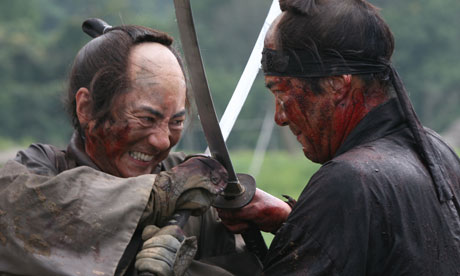
Here is the trailer for the AWESOME looking 13 Assassins that is now playing in the United States. Here is a listing of where it is showing. 13 Assassins is a remake of the original 1963 film and is directed by Takashi Miike. Miike also directed such famous films as Sukiyaki Western: Django, Ichi The Killer, and Yakuza Demon. Although a remake, this film has been getting some very good reviews, apparently the sword fighting and battle scenes are very impressive and violent. The director clearly wanted to give the feeling of the reality and horror of the actual combat, just like was done in the movie Saving Private Ryan. This is showing in Los Angeles so I will make every attempt I can to see this incredible looking samurai film.


Wednesday, March 09, 2011

Zen psychology: Daisetz Suzuki remembered

Here is a very interesting article from the Japan Times about Daisetz Suzuki, a Zen Buddhist teacher, who died 55 years ago. D.T. Suzuki is one of the great Zen teachers in modern Japanese history.

Zen psychology: Daisetz Suzuki remembered

More than any other Eastern thinker in the 20th century, Suzuki catalyzed the rise of humanistic psychology, which has spurred today's interest in spirituality and well-being


By EDWARD HOFFMAN
Special to The Japan Times

Despite the gloomy global economy, the field of positive psychology is booming. Often described simplistically by journalists as "the science of happiness," it's actually a broad focus on our strengths and talents, virtues and peak experiences in daily living. The name for this specialty originated with Martin Seligman at the University of Pennsylvania a dozen years ago. With amazing speed, it has spawned courses at hundreds of colleges, best-selling books, websites and workshops on topics like mindfulness, and wide-ranging research on the links between mood and wellness.

News photo
Zen sage: The works of Daisetz Suzuki have inspired many in the West to study and learn from Eastern philosophy and Zen Buddhism. AP PHOTO

Yet, amid this flurry of excitement, it's shameful that so little credit is given to a key figure who helped shift the focus away from Sigmund Freud's gloomy fixations to a more optimistic view of human nature: Daisetz Teitaro Suzuki. More than any other Eastern thinker in the 20th century, he catalyzed the rise of humanistic psychology in the post-World War II era — and, indirectly, today's mounting interest in spirituality and inner well-being. As 2011 marks the 55th anniversary of Suzuki's death, the time is right to remember the remarkable man born in what's now Kanazawa, western Japan.

Suzuki was descended from a long line of physicians of the samurai class. He was expected to follow in their path, but when he was only 6, his father died and this goal became financially impossible. Academically gifted, he taught English in several small towns before initiating higher education at Tokyo Senmon Gakko (the predecessor of Waseda University) and the nonregular course at the Imperial University in Tokyo. But by his early 20s, Suzuki felt drawn to spiritual matters, and became a novitiate at the Engakuji Rinzai Zen monastery in Kamakura.

What was his motivation? As Suzuki later reminisced, "My thoughts (had) started to turn to philosophy and religion, and as my family belonged to the Rinzai sect of Zen, it was natural that I should look to Zen for some of the answers to my problems (about losing my father and our family's resulting poverty)."

At Engakuji, Suzuki's mentor, the aged Roshi (Zen master) Imagita Kosen, bestowed the Buddhist name Daisetz, meaning "great humility" on his pupil. Suzuki spent long hours in zazen (sitting meditation) and immersed himself in classic Zen texts. He was especially inspired by the "Zenkan Sakushin" (Whips to Drive You Through the Zen Barrier), an anthology of writings on Zen discipline and advice compiled by a Chinese master of the Ming dynasty. Decades later, Suzuki would vividly describe these formative years in his spiritual memoir, "The Training of A Buddhist Monk."

As he later reminisced, "In the way of moral effort, I used to spend many nights in a cave at the back of the Shariden building where the Buddha's tooth was enshrined. But there was always a weakness of willpower in me, so that I often failed to sit up all night in the cave, finding some excuse to leave, such as the mosquitoes."

Suzuki may have been exceptionally modest by temperament, but he was a brilliant linguist. Recognizing this talent was Roshi Kosen's cosmopolitan successor — Shaku Soyen, who arranged for young Suzuki to work near Chicago as a professional translator of Eastern texts for the Open Court publishing firm. There for 12 years, Suzuki enthusiastically introduced Americans to classic Chinese, Japanese, Pali and Sanskrit writings — starting with Taoism's seminal text, the "Tao Te Ching." In 1907, Suzuki authored his first book, "Outlines of Mahayana Buddhism," and thus began his subsequent, nearly 60-year career as a teacher and interpreter of Zen Buddhism to the West. During his stay in the U.S., he traveled widely including a visit to Europe — expanding his translation work and connecting with Theosophists and others interested in mystical teachings for the modern world.

News photo
Training ground: Daisetz Suzuki studied Zen at Engakuji monastery in Kamakura. YOSHIAKI MIURA PHOTOS

Late in his life, Suzuki insisted that he had never planned to spend so much time residing in the U.S., but "one year grew into the next and I wound up staying in America for more than a decade. After that, I traveled around Europe for a year before returning to Japan."

During this period, Suzuki also found time for romance. In 1911, he married Beatrice Erskine Lane, an American social worker eight years his junior drawn to Zen and Theosophy. By then, he was back in Japan as an English lecturer at the Imperial University, and they wedded in Yokohama. The two would adopt a son and collaborate on many literary projects until her death in 1939, for Lane was an accomplished scholar in her own right — whose lucid book on Mahayana Buddhism still remains in print after more than 70 years. Sharing her husband's interest in psychology, she devoted an entire chapter in this work to the Buddhist concept of personality — and poetically declared that "The only definite teaching to be found in Zen is that . . . every man is a sleeping Buddha. Consequently, (one) has but to awaken his heart of wisdom by meditation to gain a direct insight into the nature of reality."

The 1920s and 1930s marked Suzuki's most productive years. Joining the faculty of Otani University in Kyoto, he taught both English and Buddhist philosophy, and received an honorary doctorate in literature. During this period, his major books included "An Introduction to Zen Buddhism," "Essays in Zen Buddhism," "The Training of the Zen Buddhist Monk," his translation of the ancient Sanskrit Lankavatara Sutra, and especially "Zen and Its Influence on Japanese Culture."

These works came to influence several major psychological thinkers of the 20th century including Carl Jung, Erich Fromm and Karen Horney. For example, Jung was fascinated by Suzuki's description of the Zen experience of satori(enlightenment) and argued that it showed that we have higher stages of consciousness beyond the ego. For Fromm and Horney, Suzuki's work pointed the way to an exciting new understanding of personality growth and psychotherapy based on the notion of a "real self" that can be nurtured through authenticity and "whole-heartedness."

Fromm admired Suzuki's Zen teaching that we grow spiritually in life not by mere words and intellect, but by involving our entire being. At the time, of course, Freudianism was the dominant approach in Europe and the U.S., and had nothing to say about such matters.

During the interwar years, Suzuki's writings also helped modern Japanese to appreciate the impact of Zen thought on their own culture. For instance, in his preface to "The Training of the Zen Buddhist Monk," Suzuki asserted that "It is impossible, as I maintain, in the study of the Orient, especially in the study of Japanese character and culture, to neglect — much less to ignore — the influence of Zen. "In Zen and Its Influence on Japanese Culture," Suzuki described Zen's impact on four different, long-standing traditions in his country: painting, literature, swordsmanship and the tea ceremony. Each of these domains is worth noting, though space constraint here necessarily make these brief.

News photo
A temple room within Engakuji monastery where Suzuki is believed to have meditated.

Artistically, the Sumiye is a kind of sketch in black and white, involving ink composed of soot and glue, a brush of sheep's or badger's hair, and thin paper designed to absorb much ink. As Suzuki noted, such frail material was intentionally chosen to make sure that the artist's inspiration was transferred onto it in the quickest possible time — allowing for no erasing, retouching or remodeling. In this way, observed Suzuki, "Sumiye attempts to catch spirit as it moves" — thereby embodying the Zen principle that in life, "Everything becomes, nothing is stationery."

As for literature, the haiku is a special product of Japanese genius, according to Suzuki, developed in its highest form by the 17th-century Zen devotee Basho. How so? Because he freed haiku from mere wordplay and connected it to the experience of ultimate truth with such poems as "A frog jumps into the water. Hear the sound!"

As for swordsmanship, Suzuki contended that in feudal times, Japanese warriors were taught by Zen masters not to learn scholarly doctrines, but to develop a specific mental attitude: fearlessness before their possible death in battle. The 16th-century Zen master Takuan also taught his disciple Yagyu Tajima no Kami (swordsmanship teacher to the shogun of his day): "What is most important in the art of swordplay is to acquire . . . 'immovable wisdom.' 'Immovable' does not mean to be stiff and heavy . . . It means the highest degree of motility with a center which remains immovable . . . You must leave your mind free to make its own countermovement without your interfering deliberation."

Finally, Suzuki contended that the Japanese tea ceremony, so integral and favored part of its culture — and similar to other long-standing artistic activities as flower arranging — embodies the spirit of sabi by emphasizing such elements as simplicity, naturalness, refinement and "familiarity singularly tinged with aloofness and everyday commonness veiled exquisitely with the mist of transcendental inwardness."

Such insights by Suzuki helped to awaken broad Japanese interest in Zen Buddhism, especially as his reputation grew in the West.

When World War II erupted, Suzuki was under the suspicion of the Japanese government for his opposition to militarism. In his numerous wartime essays on Zen, he kept quiet about political matters, but in private letters as well as public speeches, he made clear his antiwar stance. For example, the day after Pearl Harbor was bombed, the 71-year-old Suzuki plunged Otani University's faculty meeting into uproar when he contended, "With this, Japan will be destroyed. What will destroy it is Shinto and the militarists."

Such shocking words, of course, proved prophetic — and in 1949, he was made a member of the Japan Academy and decorated by the emperor with the Order of Culture.

The postwar era marked the heyday of American Freudianism and its humanistic offshoots — and Suzuki, teaching Zen Buddhism at Columbia University in the 1950s, was at the epicenter of creative psychological thought. Only months before Horney's death in 1952, she accompanied Suzuki and colleagues on a tour of Japanese Zen monasteries and emphasized the importance of his notion of "whole-heartedness" as a vital feature of mental health. Fromm became close friends with Suzuki, and in 1957, sponsored him as a guest speaker for a conference on Zen and psychoanalysis held in Cuernavaca, Mexico. Several years later, the two coauthored an influential book on this topic; like many others, Fromm was greatly touched by Suzuki's personal warmth and kindness.

Abraham Maslow, guru of motivational psychology, was another humanistic thinker inspired by Suzuki during these years. Maslow, who pioneered in studying what he called "peak experiences" — that is, sudden moments of joy and meaning — was excited by Suzuki's concept of sono-mama or suchness, as an element of mystical awareness. Sponsoring Suzuki's lectures at Brandeis University, Maslow also regarded Suzuki's Zen teaching of muga, or total absorption, as vital for a psychology of well-being and growth.

It is an historical irony, though, that Suzuki had much less impact on Japanese psychology than on its humanistic development in the U.S. and Europe. Why so? Because during the postwar years, Japanese psychologists were eager to establish their field as a rigorous experimentalist science, akin to biology, and looked askance at philosophical or spiritual thinkers. As the Jungian scholar Dr. Shoji Muramoto of Kobe City University of Foreign Studies comments, "Unlike in the West, Suzuki's relevance to modern psychology has hardly been appreciated in Japan outside of a few journal articles. Nevertheless, he was perhaps the first Zen philosopher to deal with Zen as an object of academic study in its philosophical basis and psychological aspects, as well as its history."

After retiring from Columbia University in 1957, the elderly Suzuki returned to Japan, where he kept up an active, international schedule of writing, attending conferences, lecturing and receiving awards for his lifetime achievements.

Until his death in 1966 at age 95, he influenced a new generation interested in the relevance of Eastern thought — particularly Zen Buddhism — for contemporary civilization. For instance, his writings on Zen meditation later contributed to mindfulness training for health care professionals as a valued therapeutic tool — and now sponsored by dozens of medical schools in the U.S. and elsewhere.

As Suzuki astutely saw, the world was hungry for Eastern spiritual wisdom. His final words? "Don't worry. Thank you! Thank you!"

Thursday, February 10, 2011

Tour of Duty: Samurai, Military Service in Edo

I recently read the book Tour of Duty by Constantine Nomikos Vaporis is professor of history at the University of Maryland, Baltimore County. An excellent book on the sankin kotai system, the duty of samurai to "attend" the Shogun in Edo period Japan (1603-1868).

Alternate attendance (sankin kotai) was one of the central institutions of Edo-period (1603–1868) Japan and one of the most unusual examples of a system of enforced elite mobility in world history. It required the daimyo to divide their time between their domains and the city of Edo, where they waited upon the Tokugawa shogun. Based on a prodigious amount of research in both published and archival primary sources, Tour of Duty renders alternate attendance as a lived experience, for not only the daimyo but also the samurai retainers who accompanied them. Beyond exploring the nature of travel to and from the capital as well as the period of enforced bachelorhood there, Constantine Vaporis elucidates—for the first time—the significance of alternate attendance as an engine of cultural, intellectual, material, and technological exchange.

Vaporis argues against the view that cultural change simply emanated from the center (Edo) and reveals more complex patterns of cultural circulation and production taking place between the domains and Edo and among distant parts of Japan. What is generally known as “Edo culture” in fact incorporated elements from the localities. In some cases, Edo acted as a nexus for exchange; at other times, culture traveled from one area to another without passing through the capital. As a result, even those who did not directly participate in alternate attendance experienced a world much larger than their own. Vaporis begins by detailing the nature of the trip to and from the capital for one particular large-scale domain, Tosa, and its men and goes on to analyze the political and cultural meanings of the processions of the daimyo and their extensive entourages up and down the highways. These parade-like movements were replete with symbolic import for the nature of early modern governance. Later chapters are concerned with the physical and social environment experienced by the daimyo’s retainers in Edo; they also address the question of who went to Edo and why, the network of physical spaces in which the domainal samurai lived, the issue of staffing, political power, and the daily lives and consumption habits of retainers. Finally, Vaporis examines retainers as carriers of culture, both in a literal and a figurative sense. In doing so, he reveals the significance of travel for retainers and their identity as consumers and producers of culture, thus proposing a multivalent model of cultural change. (University of Hawai`i Press)

Tour of Duty is one of nearly 200 books submitted for the 2011 International Convention of Asia Scholars (ICAS) Book Prize. The book is currently in second place with online polling taking place until March 20th. If you read this excellent book and enjoyed it like me, please go to the ICAS website and place your vote for Tour of Duty by Constatine Vaporis.

Monday, November 29, 2010

Two blogs of interest

Spike Japan has a new post titled Amakusa: Islands of dread. It details the sad history of Amakusa Island which is situated west of Kyushu. Spike Japan reveals the aspect of Japan's depopulation in much detail including Amakusa's rapid decline.

The second is from Ichijoji and is called The Death of Saigo. This post talks about the famous "last samurai" Saigo Takamori and the myths and legends surrounding Saigo's supposed seppuku during his famous rebellion.

Friday, November 19, 2010

Shogun-ki: Samurai and Death in Battle - A Translation

Shogun-ki: Samurai and Death in Battle - A Translation: "As another translation, I've (Kitsuno from Shogun-ki) picked out a section of a book called '日本の歴史・合戦のおもしろ話' (Japanese History - Interesting Tales of Battle). This translation deals with Samurai and death in battle. Everyone likes to think that Samurai were in love with the idea of death in battle and that they had no fear of death. Japanese historian Owada Tetsuo gives a much more reasonable explanation, which I hope everyone finds enlightening. This is the first of two sections I'll be translating. Due to the vague nature of Japanese, I've added some slight exposition here and there to clarify, but otherwise it is a direct translation."

Monday, September 27, 2010

Trailer - The Last Chushingura

From Nippon Cinema:

A 2-minute trailer was released for Shigemichi Sugita‘s The Last Chushingura, a new film adaptation of Shoichiro Ikemiya’s 1994 novel which was previously made into a 2004 NHK TV drama.

The film stars Koji Yakusho and Koicho Sato as the only two survivors of the legendary raid in which 47 ronin killed a corrupt court official named Kira Yoshinaka for the honor of their executed master knowing full well they’d be forced to commit seppuku afterward. Sato’s character, Terasaka Kichiemon, is a loyal retainer who’s secretly ordered to escape the raid by his leader, Oishi Kuranosuke, in order to relay the facts of the incident for the sake of posterity. Yakusho’s character, Senoo Magozaemon, is an “unworthy samurai” who flees the night before the raid and goes into hiding, establishing himself as a coward and a pariah. The two men cross paths 16 years later, and Magozaemon finally has a chance to explain his actions.

“Saigo no Chushingura” will be released by Warner Bros. in Japan on December 18, 2010.


Wednesday, July 28, 2010

Taboo (Gohatto)


From legendary director Nagisa Oshima comes a spellbinding samurai action-drama. In 1865, the Shinsengumi samurai corps is combing the new recruits for the next samurai warriors. Two are chosen: Tashiro Hyozo, a low-level samurai, and the dangerously handsome Kano Sozaburo. Rigid rules maintain order and unity, but the Shinsengumi finds itself wrought with rumors and jealously when Kano becomes the object of much fascination. (1 hour 40 minutes, 1999)

The famous and brutal Shinsengumi, the Shogun's last samurai police corps, responsible for a reign of terror against the bakufu's enemies, and infiltrated by homosexual samurai. Not what most people imagine when they think about the famed Shinsengumi of the 1860s but in reality homosexuality among the samurai was not all that uncommon. The Japanese name of the movie is Gohatto which roughly means taboo so with a name like that you pretty much knew what to expect with this film. Taboo is directed by Nagisa Oshima, one of the more highly regarded directors in Japan, and also stars Beat Takeshi. Beat Takeshi is excellent as usual in masterfully depicting the films meaning and the taboo of this time period.

This is really a quiet and plaintive movie, not a slashing sword fighting movie, but it does have an intense sword fight scene at the end. However, the plot of the movie really is rather minimal and essentially boils down to a lot of infatuated desire towards Kano. The difficulties and jealousies begin to emerge during the sparring sessions that highlight the sexual desires of a number of Kano's sparring partners. But maybe the film is deeper than it seems. A friend of mine from the Samurai Archives mentioned how she felt Kano's homosexuality was a smokescreen and I think I might agree. Maybe Kano's homosexuality and stunning looks are a tool he is using to gain power. Kano is no meek effeminate samurai. He is a bloodthirsty sword fighter who joined the Shinsengumi in order to have a license to kill. Kano is really using his beauty to gain power over the others in the organization. In reality, the meek and effeminate looking samurai exercises a much more subtle type of power in contrast to that of the power and authority held by Hijikata. Whether the homosexuality was a smokescreen or not, this was a decent film. Not amazing, not epic, not overwhelming, not shocking, but decent and I would recommend it.

Here is the trailer for the film.

Thursday, July 08, 2010

The myth of of samurai cavalry

I am republishing this 2009 post because there is such a common misconception regarding medieval samurai cavalry.

This poster from the Akira Kurosawa film Kagemusha illustrates the classic view of early samurai cavalry. Great cavalry charges of thoroughbred looking horses.


But as Karl Friday in his book Samurai, Warfare and the State in Early Medieval Japan reveals, the mounted samurai of the movies bare little resemblance to the actual mounted warriors from medieval Japan. Early medieval Japanese war-horses were actually much smaller and slower than the horses seen in classic samurai movies.

According to Friday, the mounts favored by early medieval samurai were stallions raised in eastern Japan and selected for their size and fierce temperament. They were stout, short-legged, shaggy, short-nosed beasts, tough, unruly and difficult to control.

In 1953, a mass grave at Zaimokuza near Kamakura was unearthed that is believed to contain the remains of men and horses killed during Nitta Yoshisada's attack on the city in 1333. The skeletons show the horses of the period ranged in height from 109 to 140 cm at the shoulder. Modern thoroughbreds by comparison range in height around 160 to 165 cm.

Also, these medieval horses could not sustain high speeds for long distance due to their size and the weight they were carrying, mounted samurai with full armor. Even modern racing horses can only go full out for 200 or 300 meters. Early medieval Japanese horses gave the samurai a rugged, stable, and comfortable platform from which to shoot their arrows, but it was a heavy beast not well designed for high speeds or long distance riding.

Horseman had different roles throughout the samurai era. During the Heian/Early Kamakura era they operated much like skirmishers with bows. They began to make greater use of hand-to-hand weapons like naginata and swords as time went by, ending up using primarily short yari during the sengoku. And by the late Sengoku with the advent of firearms, they did begin to function much like 'trucks'-there are many accounts where samurai were told to dismount before they reached the battlefield so as not to have their horses shot. Horses were rare and expensive, and no samurai was in a hurry to throw their horses lives and training away. (Samurai Archives)

In addition, the amount of dismounted combat in Sengoku jidai increased along with the increase with the number of guns. I think this was probably due to the fact that relatively few number of Japanese cavalry made it easier for concentrated fire of arquebus to defeat them. (Samurai Archives)

So the scenes in the movies with the cavalry charges that seem to go on forever are of course greatly embellished. But they make for an exciting movie.

Wednesday, June 09, 2010

Cool Japanese manhole covers

Throughout Japan there are manhole covers with interesting designs or colorful pictures. During my recent Japan trip I came across these two in a quiet neighborhood in the small city of Otawara in Tochigi prefecture. I love that not only do they have these interesting pictures but they are in color as well. Pretty cool.


In the upper right corner of the fire truck cover is the symbol of the city of Otawara. Most or all cities in Japan have city emblems like this. This one and others remind me of mon, the emblems used to identify families or samurai clans such as the Tokugawa.

Tuesday, June 01, 2010

Japan Trip update

This is just a brief update of my current trip to Japan, my third in the last 6 months. When I return to the States I will post some photos.

On Sunday I went to Nikko with my family and visited some of my wife's relatives. In Nikko we took our children to a local park with a playground. In spite of the cloudy and relatively cold weather, the park was crowded with children.

Today the weather was clear and warm and so we visited the Tochigi Prefectural Museum in Utsunomiya. This is an excellent museum surrounded by a beautiful park in the middle of the city of Utsunomiya in Tochigi prefecture. The museum has exhibits ranging from dinosaur bones to stuffed native Tochigi animals such as bears and foxes to giant beetles. There were also some very interesting exhibits of one of my favorite subjects, medieval Japanese history. These included painted screens of important figures such as Ashikaga Takauiji as well as other samurai era exhibits of armor, swords, and other historical artifacts. I could have spent much of the day there but with two small children we took the tour in approximately one hour, spending most of the time in the dino bone and giant beetles exhibits. :)

On Thursday weather permitting we plan to travel down to Kamakura which I have never visited before so I look forward to that.

Sunday, May 02, 2010

Hideyoshi lives and he's ready to kick North Korean butt

Hashiba Hideyoshi in rubber boots in front of his missile arsenal. (Photo from viceland.com)

Kim jong-il and North Korea may have nukes but Japan can rest easy, Hashiba Hideyoshi is alive and well and ready to kick some North Korean ass should they ever attack Japan. Yes, the great 16th century unifier of Japan, better known as Toyotomi Hideyoshi, is living in Aoyama and has built an arsenal of ballistic missiles ready to launch at the slightest provocation. The modern Hideyoshi has even created his own feudal domain called Odagawa where he has built a small castle and of course a hot spring hotel.

Apparently Mr. Hideyoshi realized who he really was when he was a young man and was told by a priest that he was the reincarnation of Toyotomi Hideyoshi. He didn't think too much of it until later from reading about the real Hideyoshi, he realized what an impressive general he was. Now Mr. Hideyoshi wears samurai armor ready for battle while holding an assault rifle. He doesn't mind that people may think he is completely mad, he's just the resident crazy man. Hideyoshi moved to Aoyama and established his Odagawa Domain where he decided to dig for a hot spring and establish a hotel. It wasn't until later after hearing about North Korea's Taepodong missiles that threatened japan, that Hashiba Hideyoshi decided to build his own missile arsenal.

According to Mr. Hideyoshi, he has seven Patriot missiles (that don't fly) and a nuclear armed 'interplanetary' ballistic missile and another missile that he calls the "Super Fighter Hashiba 7". The Hashiba 7 apparently works if it is loaded with liquid oxygen and alcohol, although I wouldn't want to be in the area when Mr. Hideyoshi fired it up. Hideyoshi has even bigger dreams. He next plans to build two Aegis class warships and an aircraft carrier, the Odagawa Domain navy.

He also has a tank armed with cannons and missiles but Hashiba states that they don't fire real ammunition. If he did fire them, he states, he would be prosecuted much more severely than just a simple weapons violation.


Hideyoshi in rubber boots in front of his castle. (Photo from viceland.com)

I learned of the modern Hashiba Hideyoshi through the Samurai Archives and an article on Mr. Hashiba Hideyoshi from viceland.com.

Saturday, April 24, 2010

Samuel Hawley's "Imjin War"

The Shogun-ki blog has an excellent part one interview with Samuel Hawley, author of The Imjin War. The Imjin War is the story of the late 16th century Japanese samurai invasion of Korea from 1592 to 1598 initiated by the powerful Japanese warlord Toyotomi Hideyoshi. Hideyoshi was the great warlord who finally succeeded in unifying Japan under his rule after more than a century of civil war. Hideyoshi's stated goal of the Korean invasion was to eventually conquer Ming China. Hideyoshi's dream was never achieved as his samurai armies, after early successes that took them to the very border with China, eventually bogged down into brutal warfare on the Korean peninsula. The failure of Hideyoshi's invasion of Korea was partly due to the intervention of tens of thousands of Ming Chinese troops that crossed the Yalu River to confront the invaders just as they did over 350 years later against the Americans. Hawley's book is probably the best English language work on the 16th Century Japanese invasion of Korea.

Here is part two of the interview with Mr. Hawley.