Daibutsu, Kamakura

Daibutsu, Kamakura
Daibutsu in Kamakura, June 2010. There were thousands of school kids visiting that day. It was still great fun.

Saturday, April 03, 2010

The Bushido Blade


The Bushido Blade (1979) 1 hour 30 minutes
Set in 19th century Japan, at the time of American Commodore Matthew Perry's (Richard Boone) opening of the ancient nation, Bushido Blade involves Perry's efforts to locate a sacred sword. The film co-stars the legendary Toshiro Mifune as the "Shogun Commander" and James Earl Jones as a whale harpooner who spouts philosophy.

This movie is so bad that it's good. It's so horrible that it is a supreme comedy. This movie is one of the cheesiest, crappiest movies I have ever seen but it had me laughing many times at the complete absurdity. The movie starts out on the USS Powhatan where the captain (Boone) is entertaining several of the shogun's samurai. I knew immediately what kind of movie this would be when the nights entertainment consisted of a bunch of dancing sailors in blackface. My jaw was on the floor when I saw that. Richard Boone had quite a performance in this film, appearing to be drunk throughout the entire movie.

As the shogun was prepared to present a sacred samurai sword to the visiting Americans, it was unfortunately stolen by a renegade daimyo lord opposed to any contact with the barbarian foreigners. The shogun's representatives state inexplicably that no treaty can be signed without the sacred sword. OK? Anyways, although the shogun's samurai state they will get the sword back, of course the American's think they can do the job better. So the captain sends three of his best sailors into Japan to get the sword back themselves because of course no one can get the job done as good as the Americans. And that's where the real hilarity begins. The sailors get separated, each encountering various adventures, including running into Darth Vader, I mean James Earl Jones, a whaler who is being held in captivity. One of the funniest scenes occurs when Vader initiates a bathing room brawl against their Japanese captors allowing one of the sailors, a big goofy redhead, to escape out the window. There are just too many damn funny scenes to mention and I don't want to give them all away. Although this is truly a horrible, horrible movie, I still recommend this just for the sheer hilarity.

Friday, March 26, 2010

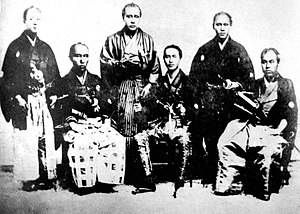
150th Anniversary of 1st Japanese Embassy to America

Samurai sailors from the Kanrin Maru. (Wikipedia Commons)

This month marks the 150th anniversary of the first official Japanese embassy to the United States. In 1860, the Tokugawa shogunate government sent a group of samurai to America in order to ratify treaties between the two countries. The treaties were the result of the visit by the American "Black Ships" in 1853 headed by Commodore Matthew Perry whose purpose was to "pry open" the country of Japan. Although there had been a small handful of Japanese who had visited the United States previously, this official visit attracted much attention and curiosity among the citizens of San Francisco and the nation. Thousands lined the shore in San Francisco to watch the arrival of the Kanrin Maru, the small Japanese ship manned by samurai sailors. The Kanrin Maru was piloted by Katsu Kaishu, the man who would be the mentor to Sakamoto Ryoma, one of the famous leaders of the Bakumatsu period and the restoration of the emperor.

Newspapers reported on the visit to the smallest of details and reflected on the popular view of the time at how awed these visitors would be as they encountered Western civilization and American progress. However, that outlook changed when the stately, and always polite, Japanese ambassadors occasionally encountered rowdy crowds who mobbed them to get a glimpse of the exotic Japanese. Dismayed by these unseemly popular displays, some editorials began asking just who was really more "civilized".

While the Kanrin Maru and her crew remained in San Francisco for a period of time before returning to Japan, the embassy leaders traveled to Washington to meet President Buchanan at the White House where they were treated to formal dinners. In New York, the Japanese were welcomed by a grand parade up Broadway watched by half a million people. Unfortunately the excitement of the embassy was soon washed away by the civil wars that engulfed both nations later in the 1860s.

To mark the historic event, the city if San Francisco dedicated a bronze plaque last week at Pier 9 to honor where the samurai from the Kanrin Maru came ashore on March 17, 1860. Other events will include the planting of sakura trees in Japantown and a visit by a Japanese tall ship on May 5th as well as an exhibition at the Asian Art Museum called "Japan's Early Ambassadors to San Francisco."


President Buchanan receiving the embassy in Washington. (Wikipedia Commons)

Friday, March 19, 2010

Bushido: The Cruel Code of the Samurai


Synopsis:
In this classic piece of Japanese samurai cinema, modern-day businessman Susumu (Kinnosuke Nakamura) ponders seven generations of his samurai family, their codes, traditions and history of stark violence, as he comes to terms with his own place in the lineage. Nakamura takes on multiple roles, portraying not only Susumu, but his succession of ancestors, stretching back through 350 years of Japanese feudal history.

Black and white film released in 1963

Wow, what a great and shocking movie. A true masterpiece of Japanese samurai film. A must, must see. The film begins in modern time when Susumu Iikuru visits his fiancé at the hospital after she attempted suicide. What brought his fiancé to attempt to kill herself causes Susumu to reflect on his unethical actions as a salaryman that led to this as well as reflect on the long and troubled history of his family. Susumu’s family history stretches back through seven generations of samurai who had to live by the strict code of Bushido. The movie moves through a different story for each generation and each story ends in some shocking manner, the story of Susumu's family member who must "serve" his lord being the most shocking of all (I won't give it away, you have to see it). Kinnosuke does an incredible job portraying each of the seven generations of his family. This is the first of only two Japanese films to win the Golden Bear award from the Berlin Film Festival, the second being Miyazaki's Spirited Away in 2002. In addition, Nakamura won the Japanese Best Actor award for his part in this film. What is also interesting is that when this film was released in the 60s, the concept of the Japanese salaryman devoting his life to the company like a true samurai was strong and this film was a direct criticism of that philosophy.

Monday, March 15, 2010

Toyota casts doubt on runaway Prius claim

Toyota casts doubt on runaway Prius claim - Autos- msnbc.com: "SAN DIEGO - Toyota said there were 'significant inconsistencies' between a California man's claim that his Prius sped out of control and the findings of the company's preliminary investigation.

Toyota said in a statement that the accelerator pedal was tested and found to be working normally and a backup safety system worked properly. The automaker said the front brakes showed severe wear and damage from overheating, but the rear brakes and parking brake were in good condition."

The first time this story came out I was suspicious. It just didn't sound right and with how litigation-happy American's are, it was only a matter of time that someone would try a scam Toyota. Nothing has been proven yet but the evidence regarding this particular case is pointing to the driver not being honest about what happened. And it is logical to assume that the driver was attempting to scam Toyota. If it is eventually proven that the drive was lying, he should be put in Jail. Bad publicity like this potentially could cost Toyota millions in lost revenue.

Sunday, March 14, 2010

Japanese man killed by Light Saber

Kirainet, a blog I enjoy visiting often, periodically posts hilarious photos of sleeping Japanese. The two below are a couple of the funniest ones I've seen. The guy looks like he was killed in a light saber battle, possibly with Count Dooku.


Photos courtesy of Kirainet.com

Friday, March 12, 2010

Story behind the famous Tsurugaoka Hachiman tree

A very famous 1000 year old ginkgo tree at the Tsurugaoka Hachiman shrine in Kamakura fell in a recent storm. There is a very interesting story about this very old tree. The tree is famous because of an event that took place in the year 1219. In 1219, Shogun Minamoto no Sanetomo was assassinated by Minamoto Kugyô. From the stories I’ve read, apparently Kugyô hid behind this very ginkgo tree in order to assassinate Sanetomo which he succeeded in doing. Kugyo was captured and beheaded the next day. Sanetomo was the 3rd Minamoto shogun during the Kamakura bakufu and it was following his assassination that the Minamoto never again had effective power. From that point forward, the true power behind the Kamakura shoguns was held by the regents of the great Hojo clan.

I don't know if Minamoto Kugyô really did hide behind this great gingko tree but it is an amazing story from one of the great events in Japanese history so it is sad to see this tree finally meet its end here in the year 2010.


Photos are from Wikipedia Commons and are labeled for reuse.